Budget 2026 $400m Growth Fund for Council Housing Consents — Economic News
BUDGET 2026 · HOUSING INCENTIVES
Budget 2026: $400m Fund Ties Council Payments to Housing Consents
Budget 2026 allocates $400 million over four years to an Incentives for Growth Fund that pays councils directly for each new home consented, with payments starting in April 2027.
"Councils have spent years treating growth as a problem to manage. The Incentive Fund changes the calculus. When more consents mean more revenue, councils will find ways to issue them."Oliver Hartwich, New Zealand Initiative executive director
The New Zealand Treasury published the Investment Decision Assurance Policy on 13 October 2026. The framework consolidates the Gateway reviews and Te Waihanga's Infrastructure Priorities Programme into one investor-focused process effective 1 November 2026.
The Green Party announced a $5.9 billion economic development plan on 13 October 2026 that it claims will create 284,000 jobs over four years, 64,000 more than Treasury forecasts.
National Finance spokesperson Nicola Willis stated that income tax cuts are off the table until after a return to surplus, projected for 2028/29 under Treasury forecasts.
Budget 2026 allocates $400 million over four years to an Incentives for Growth Fund that pays councils directly for each new home consented, with payments starting in April 2027.
Mechanism and Scale
The Incentives for Growth Fund provides up to $100 million annually through a tagged contingency. Payments begin at 0.25 percent of the average construction cost of a typical new-build New Zealand home per consented dwelling. The rate doubles to 0.5 percent once annual growth reaches 1 percent of a council's existing housing stock. It rises further to 1.25 percent for growth beyond 2 percent.
A council with 10,000 existing homes must approve more than 200 new homes in a year to reach the top payment tier.
Incentives for Growth Fund: Payment Tiers
Annual housing growth threshold
Payment rate (% of avg construction cost)
Up to 1% of existing housing stock
0.25%
1% to 2% of existing housing stock
0.50%
Beyond 2% of existing housing stock
1.25%
Payments are calculated as a percentage of the average construction cost of a typical new-build New Zealand home per consented dwelling.
Source: Budget 2026, NZ Herald / HUD
Council Infrastructure Pressures
Councils have long front-loaded infrastructure costs for roads, pipes and parks while recouping revenue slowly through rates and development contributions. The fund seeks to align incentives by sharing some of the fiscal upside that currently flows to central government.
The New Zealand Initiative advocated for more than a decade for a 50/50 GST-sharing model on residential building consents. That approach was estimated to deliver over $1 billion annually, or about 6 percent of total council revenue. The new fund represents just 0.6 percent.
Councils have spent years treating growth as a problem to manage. The Incentive Fund changes the calculus. When more consents mean more revenue, councils will find ways to issue them.
— Oliver Hartwich, New Zealand Initiative executive director
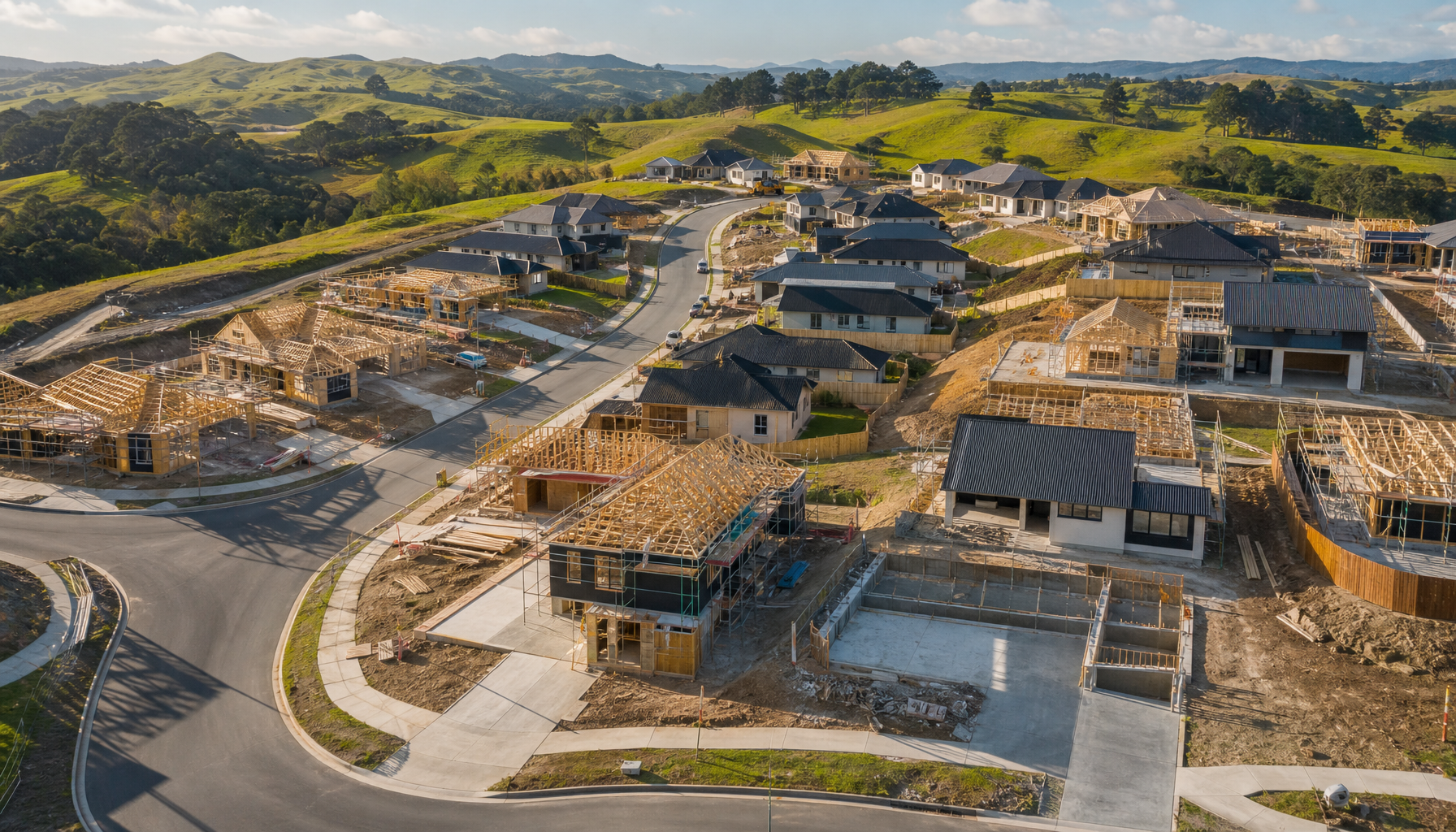
AI illustration of a New Zealand residential subdivision under construction — the type of development the Incentives for Growth Fund aims to accelerate by rewarding councils for each new home consented.
Macro Fiscal Context
Treasury forecasts show annual average GDP growth accelerating from 1.2 percent in the year to June 2026 to 3.2 percent by June 2028. Employment is expected to rise by 220,000 and wages to grow 3.1 percent on average over four years.
The operating package came in at $2.1 billion, under the $2.4 billion allowance. This supports an earlier return to OBEGALx surplus in 2028/29. Net core Crown debt is projected to peak at 46.1 percent of GDP in 2027/28 before declining to 44.4 percent by the end of the forecast period.
Net Core Crown Debt Forecast (% of GDP)
Debt peaks in 2027/28 before the projected fiscal consolidation takes hold.
Source: Budget Speech 2026, Treasury
Stats NZ data show 37,813 new dwellings consented in the year to March 2026, up 11 percent on the prior year. Stand-alone house consents reached 17,444, an increase of 9.2 percent.
New Dwellings Consented — Year to March
Stand-alone house consents rose 9.2% to 17,444 in the year to March 2026.
Source: Stats NZ Building Consents, March 2026
Implementation and Risks
The fund excludes water infrastructure, which will be handled by new water service entities. Early details on eligibility, verification and interaction with development contributions will determine effectiveness.
Brad Olsen of Infometrics described the policy as a really interesting proposition but called for it to be made permanent rather than limited to four years.
The modest scale relative to total council capital expenditure and the estimated $1.29 billion annual consenting costs borne by developers limits potential impact. Success could support faster supply growth, moderating price pressures and expanding the rates base over time.
Second-order effects include construction sector employment gains already supported by the Budget's $7 billion infrastructure allocation. The policy aligns with the Going for Growth agenda but its $100 million annual ceiling remains small compared with earlier GST-share proposals.