The New Zealand Treasury published the Investment Decision Assurance Policy on 13 October 2026. The framework consolidates the Gateway reviews and Te Waihanga's Infrastructure Priorities Programme into one investor-focused process effective 1 November 2026.
The Green Party announced a $5.9 billion economic development plan on 13 October 2026 that it claims will create 284,000 jobs over four years, 64,000 more than Treasury forecasts.
National Finance spokesperson Nicola Willis stated that income tax cuts are off the table until after a return to surplus, projected for 2028/29 under Treasury forecasts.
Budget 2026 allocates more than $680 million in new capital spending for hospital upgrades and capacity expansion across New Zealand.
The funding targets major sites including Whangārei, Tauranga, Hawke's Bay and Palmerston North. It forms the next phase of the 10-year Health Infrastructure Plan that identifies more than $20 billion in required investment.
Health New Zealand will add a further $930 million over the coming year for clinical equipment, technology and facility improvements. Total Vote Health investment reaches $34.07 billion after a $1.37 billion uplift.
"We are focused on building the future of hospital infrastructure so Kiwis can access timely, quality care when they need it." — Health Minister Simeon Brown, Beehive.govt.nz
Health Minister Simeon Brown said Budget 2026 delivers the capital spending to strengthen hospital infrastructure, expand capacity, and ensure patients and staff have access to modern, resilient facilities.
Regional projects and phased delivery
Whangārei Hospital will gain a new 158-bed ward tower. Completion is scheduled for late 2031. Design and enabling works will begin at Tauranga, Hawke's Bay and Palmerston North under the Regional Hospital Redevelopment Programme.
Health New Zealand will also fund a temporary intensive care unit at Palmerston North and an inpatient unit fit-out at Tauranga. Land acquisition is underway for a new hospital in the Drury area south of Auckland.
Upgrades at Auckland's Mason Clinic will improve resilience at the country's largest forensic psychiatric service. Earlier commitments funded include the Dunedin Hospital inpatient building and Waikato medical school establishment costs.
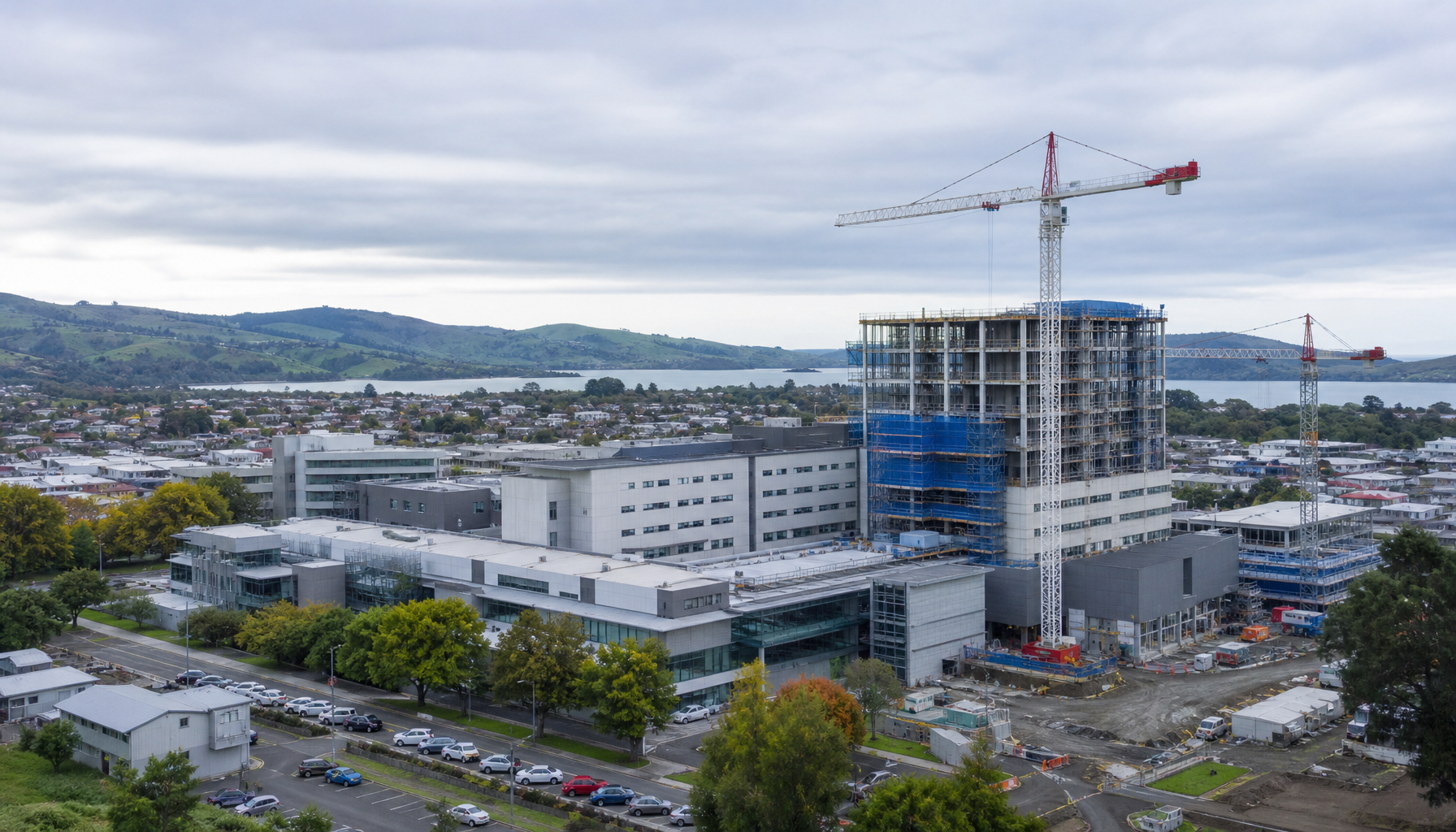
AI illustration of a New Zealand regional hospital expansion, representing the scale of capital works funded under Budget 2026's $680 million health infrastructure package.
Fiscal context and delivery risks
The package sits inside a tight $2.1 billion operating allowance for all new government spending. Past projects show delivery risks. The Dunedin Hospital inpatient building budget has risen to approximately $2.054 billion, according to RNZ reporting based on Treasury's quarterly investment report.
Phased construction pairs large redevelopments with interim measures to limit service disruption. Operating funding must keep pace with new capacity or the investments risk becoming stranded costs.
Treasury oversight of capital allowances will test whether the programme stays within fiscal limits while meeting population growth and ageing demands in regions such as Northland and South Auckland.
Vote Health Funding Growth
Bars show total Vote Health allocation at selected Budget years.
Source: The Conversation / Budget.govt.nz / Health.govt.nz Cabinet paper
The Labour health spokesperson had not responded to a request for comment at the time of publication.