Budget 2026 Forecasts $2.6bn OBEGALx Surplus in 2028/29
Finance Minister Nicola Willis delivered Budget 2026 on 28 May 2026, forecasting an OBEGALx surplus of $2.6 billion in 2028/29, a year earlier than the December 2025 HYEFU projection of a $900 million deficit.
"Nicola Willis has given New Zealanders nothing to ease the pressure they are under. Instead of helping struggling New Zealanders, Christopher Luxon and Nicola Willis chose to make lives harder."Chris Hipkins, Labour leader
The New Zealand Treasury published the Investment Decision Assurance Policy on 13 October 2026. The framework consolidates the Gateway reviews and Te Waihanga's Infrastructure Priorities Programme into one investor-focused process effective 1 November 2026.
The Green Party announced a $5.9 billion economic development plan on 13 October 2026 that it claims will create 284,000 jobs over four years, 64,000 more than Treasury forecasts.
National Finance spokesperson Nicola Willis stated that income tax cuts are off the table until after a return to surplus, projected for 2028/29 under Treasury forecasts.
Finance Minister Nicola Willis delivered Budget 2026 on 28 May 2026, forecasting an OBEGALx surplus of $2.6 billion in 2028/29, a year earlier than the December 2025 HYEFU projection of a $900 million deficit.
Treasury's Fiscal Strategy Report confirms the accelerated timeline despite global uncertainties including the Iran conflict. The update follows post-pandemic spending growth under the prior Labour government.
Treasury's HYEFU 2025 had projected an OBEGALx deficit of $13.9 billion in 2025/26, or 3.0 percent of GDP — the largest since 2019/20. Core Crown expenses are targeted toward 30 percent of GDP, with net core Crown debt on a downward path toward 40 percent of GDP.
The government will cut 8,700 public service roles, reducing the core public service to no more than 55,000 full-time equivalents by mid-2029. Savings total $2.4 billion, with most reductions after the November election.
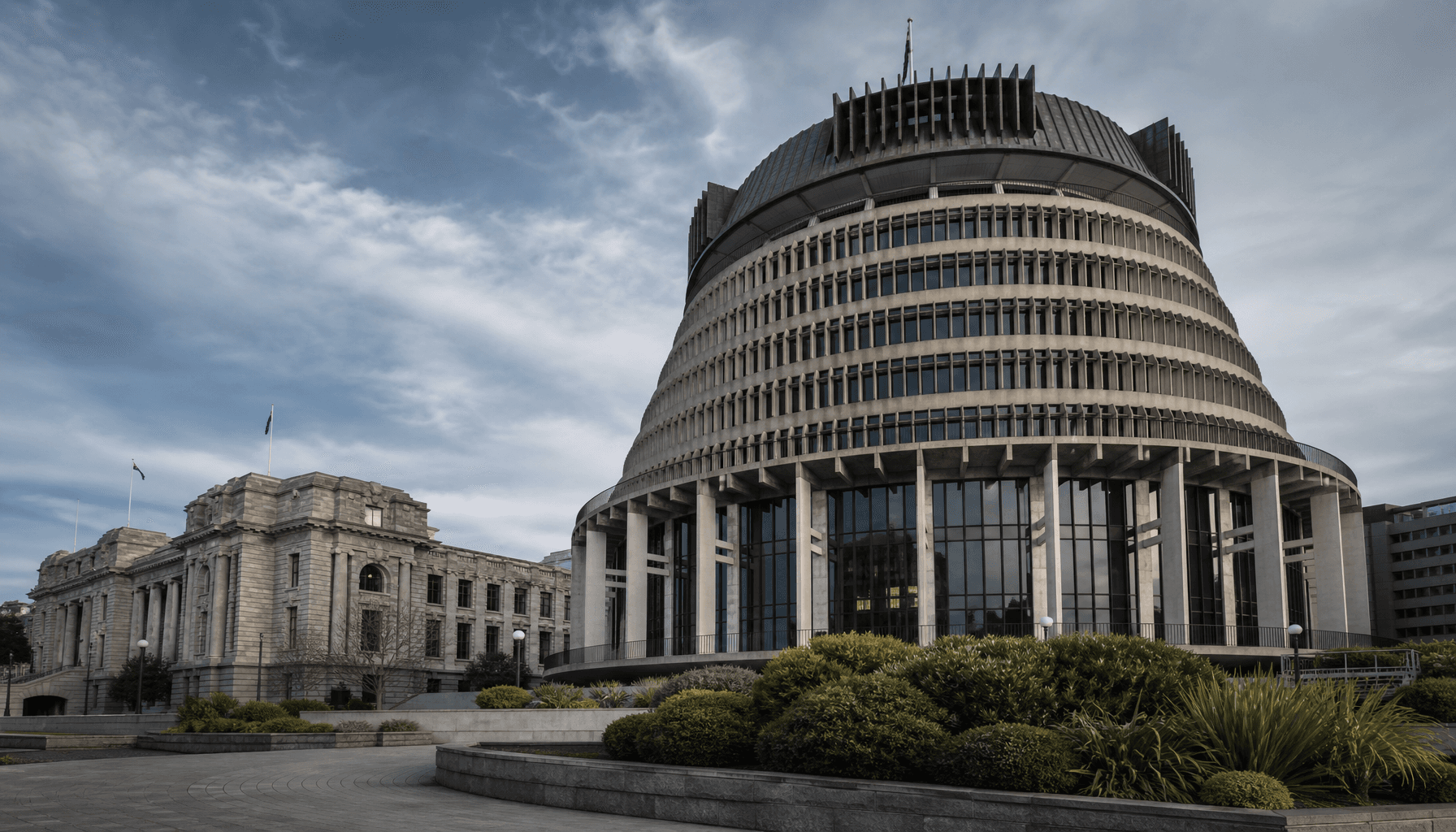
AI illustration of Wellington's government precinct — the setting for Finance Minister Nicola Willis's Budget 2026 delivery on 28 May 2026, which forecast a return to OBEGALx surplus a year ahead of schedule.
Opposition: Immediate Pain, No Plan
Labour leader Chris Hipkins criticised the approach.
"Nicola Willis has given New Zealanders nothing to ease the pressure they are under. Instead of helping struggling New Zealanders, Christopher Luxon and Nicola Willis chose to make lives harder."
Labour finance spokesperson Barbara Edmonds highlighted 40,000 additional unemployed since Prime Minister Christopher Luxon took office and claimed cuts to the building sector cost 20,000 construction jobs.
Coalition Support and Fiscal Validation
ACT leader David Seymour welcomed the end of wasteful spending. ACT contributed to $14 billion in reduced spending across the past three Budgets, he said.
Treasury's independent forecasts underpin the surplus projection. Downside scenarios still show a return to surplus by 2028/29.
Health, Housing and the Debt Path
Budget 2026 allocates an extra $1.37 billion to Health NZ, bringing total investment to $34.07 billion. It adds $69.2 million to the Flexible Fund for 1,800 to 2,250 additional social homes over three years.
The early surplus path balances targeted investments in health and housing against operating allowance constraints and public service reductions. Whether near-term restraint supports longer-term fiscal sustainability remains the central question for households and businesses.
OBEGALx Balance Forecast vs Prior Baseline
Budget 2026 accelerates the return to surplus by one year versus the December 2025 HYEFU baseline.