Fuel Tax Protest NZ plans 40-plus rallies as Government rejects broad cuts
More than 40 Fuel Tax Protest NZ demonstrations are planned nationwide for Saturday 16 May 2026, as Transport Minister Chris Bishop rejected broad excise cuts as fiscally unsustainable and untargeted, citing competing budget priorities.
"The Government is not in a position to reduce fuel taxes in a way contemplated by the protesters. It would be untargeted and expensive and come at the expense of other Government priorities like improving maintenance of our roads."Chris Bishop, Transport Minister
Auckland’s potential $5 billion Fast-track infrastructure exposure and 16,270 wrongly suspended Winter Energy Payments have become the first real-world stress tests of the Regulatory Standards Act 2025.
Cabinet’s Economic Policy Committee has formally authorised public consultation on a prudential levy to shift Reserve Bank supervision costs onto banks, insurers and market infrastructure operators from 2027/28.
Cabinet has agreed in principle to three shifts in public performance reporting sought by the Finance and Expenditure Committee, while parking detailed design and costings until 2027.
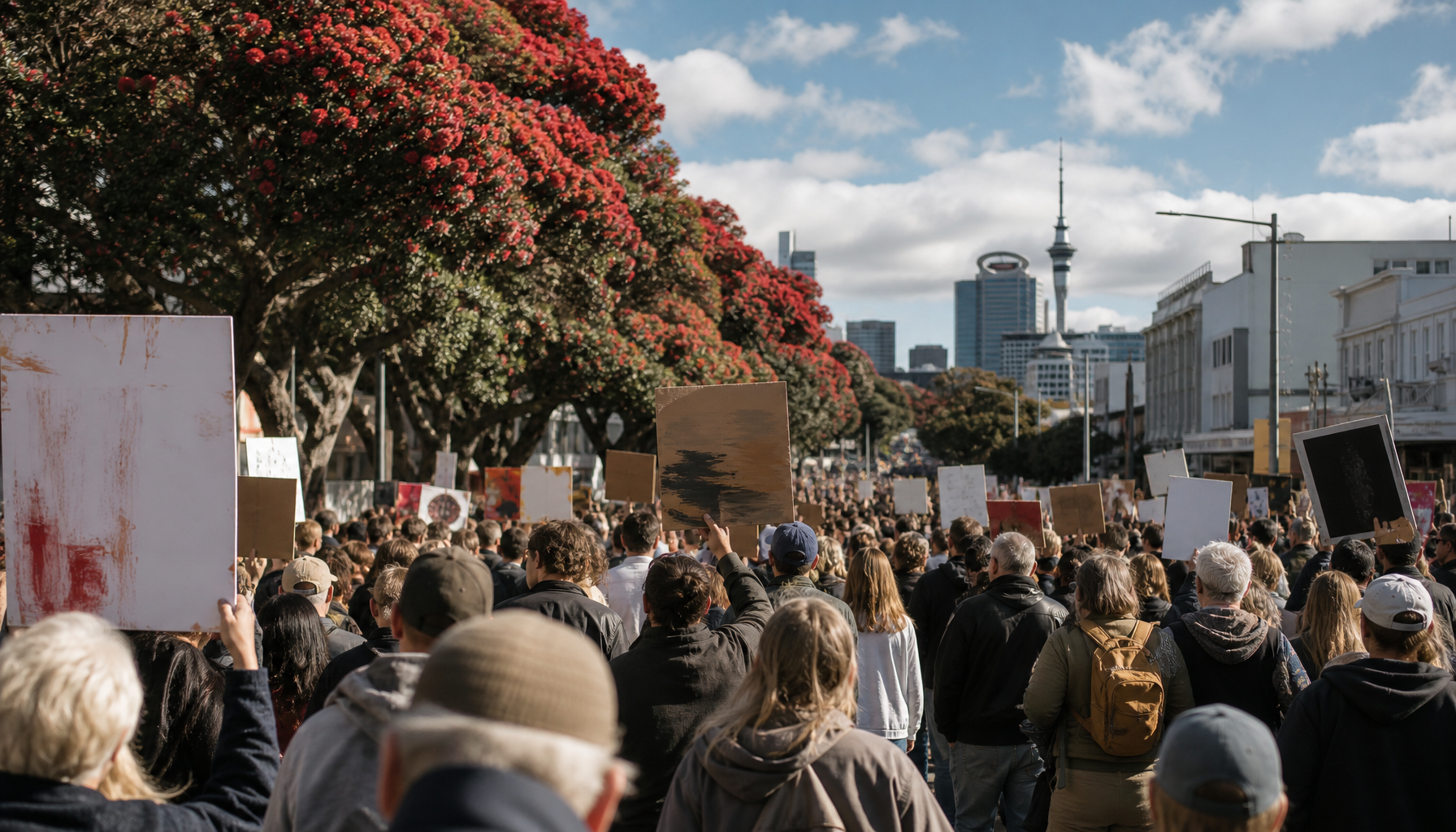
Illustration: Fuel Tax Protest NZ is coordinating more than 40 simultaneous rallies across New Zealand on Saturday 16 May 2026, from Northland to Southland.
More than 40 Fuel Tax Protest NZ demonstrations are planned nationwide for Saturday 16 May 2026, as Transport Minister Chris Bishop rejected broad excise cuts as fiscally unsustainable and untargeted, citing competing budget priorities.
Organiser Phil Barrett, who participated in the 2022 Parliamentary occupation, described the protests as "peaceful and lawful" with clear expectations set for attendees. Police have stated they are aware of the planned events and will focus on safety and minimising disruption while recognising the right to protest.
Protesters are demanding reduction in fuel taxes, scrapping of future increases, removal of the Emissions Trading Scheme levy from petrol and diesel, halting of road-user charges, and greater transparency over fuel-related revenue spending.
Chris Bishop stated: "The Government is not in a position to reduce fuel taxes in a way contemplated by the protesters. It would be untargeted and expensive and come at the expense of other Government priorities like improving maintenance of our roads." Bishop said the fuel tax has remained at a flat rate of about 70 cents per litre since the crisis began and that a planned fuel tax increase scheduled for January 1, 2027, was "unlikely to go ahead."
"The Government is not in a position to reduce fuel taxes in a way contemplated by the protesters. It would be untargeted and expensive and come at the expense of other Government priorities like improving maintenance of our roads." — Chris Bishop, Transport Minister
The fuel price shock driving the rallies
The protests emerge amid a sharp escalation in retail fuel prices driven by global oil market volatility linked to Middle East developments. Petrol prices rose 18.6% and diesel prices rose 42.6% in the month to March 2026, the largest monthly increases since Stats NZ began publishing monthly vehicle fuel price movements in July 2011. Average retail petrol price reached approximately $3.26 per litre for 91 octane in late April 2026, with reports of $3.50 per litre in some periods.
This fuel price surge contributed to annual inflation holding at 3.1% for the year to March 2026, with further upward pressure expected. Fuel spending rose 3.5% in the March quarter alone, with estimates showing New Zealand spent approximately $1.79 billion on petrol and diesel in March 2026.
Petrol and diesel monthly price rises, March 2026
Largest monthly increases since Stats NZ records began in July 2011.
Source: Stats NZ, Petrol and diesel prices up in March 2026
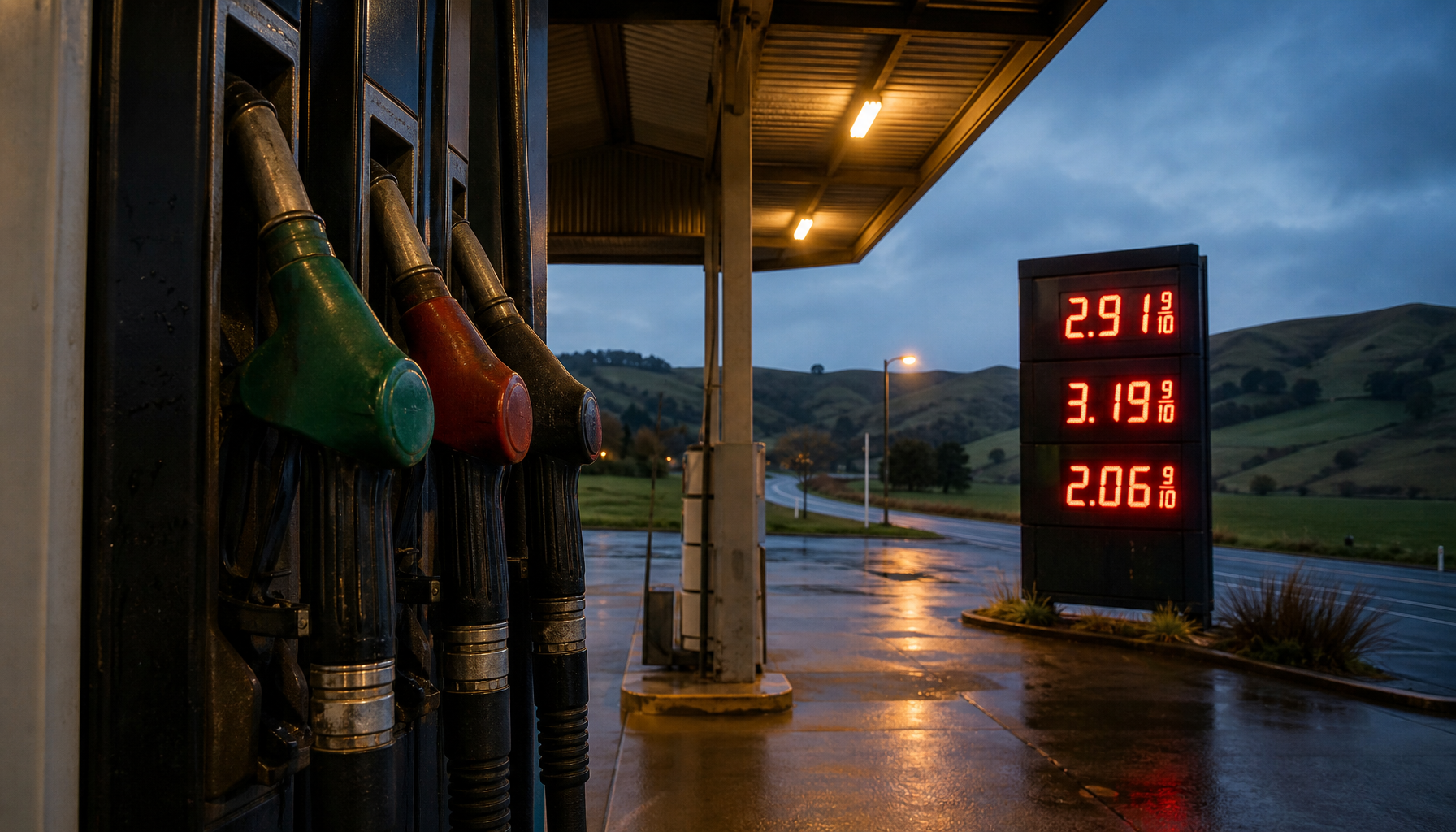
Illustration: Average 91 octane petrol reached approximately $3.26 per litre in late April 2026, with some sites reporting $3.50 — the highest levels since Stats NZ began tracking monthly fuel price movements in 2011.
The tax structure: what drivers pay
New Zealand's fuel tax structure comprises multiple layers. Petrol excise duty stands at 70.024 cents per litre for the National Land Transport Fund, with an additional ACC levy of 6 cents per litre. The Emissions Trading Scheme levy on petrol and diesel is approximately 11–18 cents per litre as of early May 2026, varying with the NZU carbon price. Together, these fixed and variable levies add roughly 87–94 cents per litre to the wholesale price before GST.
Fuel excise and road user charges together raise around $4 billion annually for New Zealand's transport network, with the bulk flowing into the National Land Transport Fund to fund road maintenance and construction.
Fuel tax and levy breakdown per litre of petrol
ETS levy shown at mid-range estimate. All figures exclude GST.
Source: Ministry of Transport; MBIE, Duties taxes and direct levies on motor fuels in New Zealand
Government's fiscal position and historical context
The Government has signalled it is open to delaying or scrapping the planned 12 cents per litre fuel excise increase from January 2027, followed by 6 cents in 2028 and 4 cents annually thereafter. However, Bishop ruled out changes to road-user charges, noting they help fund road maintenance alongside fuel taxes.
Core Crown tax revenue for the seven months to 31 January 2026 was $70.4 billion, broadly in line with forecast, according to the Treasury Interim Financial Statements. This underscores limited headroom for untargeted relief amid competing priorities like road maintenance funded by the National Land Transport Fund.
Historically, the National-led Government inherited and later ended Labour-era temporary 25 cents per litre excise cuts (2022–2023, total cost approximately $2 billion) once global pressures eased, returning to the standard 70.024 cents rate from July 2023. The Government has passed limited tax relief amendments, including temporary support for low-to-middle income working families via tax changes in March 2026, without broad excise cuts.
Road user charges transition ahead
The Government is advancing legislation in 2026 to enable electronic road user charges for light vehicles, with the system targeted to be open for business in 2027 as a replacement for petrol excise. This shift aims to move to distance-based fairness but is drawing protester criticism, as RUCs are explicitly ruled out for immediate change.
Bishop said the flat-rate structure of excise has not changed since earlier crises and that fuel taxes are fixed per litre and do not automatically rise with pump prices, unlike GST which increases with higher retail prices.
Broader fiscal and economic implications
The episode highlights New Zealand's vulnerability to imported energy costs in a high global oil environment, exacerbating household budgets while the fiscal position remains constrained. Treasury and Finance Minister Nicola Willis have prioritised targeted relief over broad cuts to preserve fiscal space amid Budget 2026 pressures, where untargeted excise reductions could cost hundreds of millions annually and crowd out other priorities like debt servicing or social spending.
Fuel-driven inflation has prompted economist commentary on potential Reserve Bank rate considerations. Over the medium term (2026–2028), the shift to electronic RUC for 3.5 million light vehicles promises more stable, usage-based revenue but risks further political friction if perceived as an additional burden during price spikes.
Barrett confirmed participation in the 2022 Parliament occupation and stated lessons were learned to ensure the May 2026 protests remain peaceful, warning it may not stay "as friendly and as sensible" if concerns are unaddressed. Organisers report the movement is "organic" with regional organisers responsible for local events, and the group is prepared to continue protesting beyond 16 May if demands are not met.
The protest thus pits populist demands for immediate cost-of-living relief against the Government's fiscal discipline and long-term transition to user-pays road funding, with second-order effects likely rippling into inflation expectations, Reserve Bank OCR deliberations, and household spending patterns through 2026.