Regulatory Gap Blocks Private Hydrogen Exploration as Gas Reserves Hit 20-Year Low
New Zealand's Crown Minerals Act contains no provisions for naturally occurring hydrogen, leaving explorers without clear title at the exact moment domestic gas output has collapsed to levels that force expensive LNG imports from 2027.
"Hydrogen is not in the Crown Minerals Act and it's not really a mineral because it's a gas. So, there's a real need for legislation and clarity on the legislation to encourage companies."Paul Viskovic, geomodeller, Earth Sciences New Zealand
Auckland’s potential $5 billion Fast-track infrastructure exposure and 16,270 wrongly suspended Winter Energy Payments have become the first real-world stress tests of the Regulatory Standards Act 2025.
Cabinet’s Economic Policy Committee has formally authorised public consultation on a prudential levy to shift Reserve Bank supervision costs onto banks, insurers and market infrastructure operators from 2027/28.
Cabinet has agreed in principle to three shifts in public performance reporting sought by the Finance and Expenditure Committee, while parking detailed design and costings until 2027.
New Zealand's Crown Minerals Act contains no provisions for naturally occurring hydrogen, leaving explorers without clear title at the exact moment domestic gas output has collapsed to levels that force expensive LNG imports from 2027.
New Zealand faces an acute gas supply crunch. Proven and probable reserves stood at 731 PJ on 1 January 2026, down 23 percent in a single year according to MBIE data released 14 May 2026. Production fell to 91.9 PJ in 2025 and is forecast at 85 PJ for 2026.
The government has shortlisted contractors for a Taranaki LNG import terminal expected to cost more than NZ$1 billion and become operational as early as mid-2027. MBIE modelling projects annual savings of at least $265 million once the facility operates.
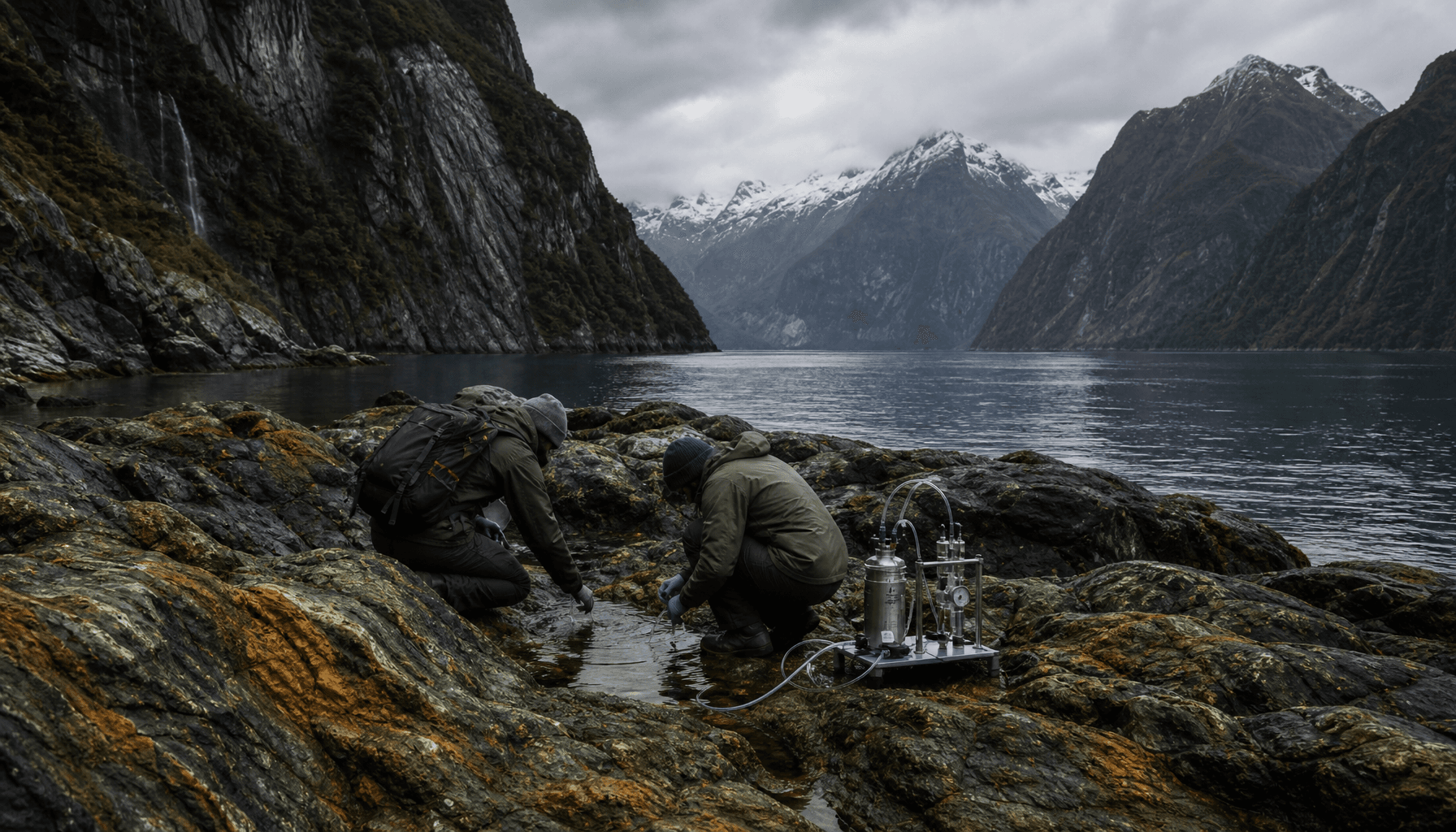
Yet geologists have identified ultramafic rock belts capable of generating natural hydrogen through serpentinisation directly beneath Auckland, Nelson, Hamilton and Taranaki demand centres. The same process that produced a sustained 76 percent hydrogen seep at Poison Bay in Fiordland for at least 40 years is active under major population centres.
The Taranaki region, New Zealand's historic gas heartland, is the proposed site of the LNG import terminal planned for mid-2027 — and one of the ultramafic belt zones where natural hydrogen generation has been identified.
The binding constraint: legislation
Paul Viskovic, geomodeller at Earth Sciences New Zealand, stated the core problem plainly: that hydrogen is not in the Crown Minerals Act and is not really a mineral because it is a gas, and that there is a real need for legislation and clarity on the legislation to encourage companies.
MBIE released a discussion document in May 2025 outlining regulatory options. Submissions closed on 4 July 2025. Industry submissions, including from Energy Resources Aotearoa, favoured customising the Crown Minerals Act rather than a wholly new regime. No final decision has been announced as of 25 May 2026.
Minister Shane Jones hosted a parliamentary roundtable in April 2026. He noted that geopolitics was really afflicting New Zealand's sense of resilience.
Gas production collapse in numbers
The decline has been relentless. According to Enerdata, output peaked at 6.5 bcm annually and stood at 3.2 bcm in 2024. Eight consecutive quarters of decline were recorded through Q3 2025.
New Zealand Natural Gas Production
Eight consecutive quarterly declines recorded through Q3 2025.
Source: MBIE; Enerdata
Science provides the fingerprint
Kevin Faure at the National Isotope Centre explained the method, saying the team is interested in looking at the isotopes of gas because that tells them about the source of the gas and what its journey was.
Thijs van Soest noted that a Fiordland sample contained high helium levels that could of itself be a resource for medical applications.
Viskovic described the Poison Bay seep as a reference site only, noting it will never be developed as an energy source, but that the geochemical signature helps identify targets elsewhere.
Trade-offs in regulatory design
Speed versus certainty is the central tension. Amending the Crown Minerals Act offers familiarity to existing permit holders yet risks disputes over grandfathering and Treaty claims. A bespoke regime requires new drafting and raises compliance costs for early movers such as PacExCo and Weora Ltd.
Exploration incentive versus fiscal capture presents another choice. The Crown has stated it will not assert blanket ownership. This preserves private upside but forgoes immediate revenue streams that could offset LNG terminal costs.
Localised production near urban centres lowers transport costs compared with a single Taranaki terminal. However, reservoir scale and renewability remain unquantified.
Helium co-production could improve project economics. Medical-grade helium already commands high prices. Yet fugitive hydrogen emissions during extraction raise questions for emissions accounting.
Second-order effects
Skills developed in isotope geochemistry at the National Isotope Centre could transfer to geothermal and minerals exploration. Early mineral permits create de-facto expectations of grandfathering. Any later regime change would damage regulatory credibility.
Pressure will fall on RMA successor legislation when the first natural hydrogen applications arrive. Iwi engagement occurred in March–April 2025, but co-management claims on ophiolite belts remain unresolved.
Historical parallel
GNS Science last sampled Poison Bay in 1989. The seep has vented continuously since the 1950s. The current effort reframes that academic data as a commercial target under acute supply pressure.
The 1950s documentation of the Fiordland seep parallels today's Lake Pupuke fieldwork. Both occurred against a backdrop of energy security concerns.
Counter-argument
Resource estimates remain speculative. No large-scale production permits exist. Environmental risks including leakage, co-contamination with methane or CO2, and uncertain reservoir renewability could outweigh benefits. The LNG terminal is already in procurement. Green and orange hydrogen pathways face lower regulatory friction.
These points carry weight. Commercial viability at scale is unproven. Environmental and Treaty considerations could delay projects for years.
Open questions
What is the updated MBIE timeline for a final regulatory decision? Will the regime include explicit grandfathering language for existing permit holders?
How will reservoir scale and renewability be quantified before the 2027 LNG final investment decision? What minimum economic flow rate justifies commercial drilling?
Will helium co-production receive royalty credits or emissions budget recognition?
What fiscal modelling compares permit revenues against avoided LNG import levies under different scenarios?
Next steps for investors and policymakers
Regulatory clarity within the next 12 months would allow permit holders to advance exploration while the LNG terminal remains in planning. Successful flows near demand centres would reduce exposure to global price shocks and import dependence. The window is narrow. Gas production continues to fall and the import facility moves toward contract award in mid-2026.