Wellington Airport Seawall Fast-Tracked Under 2024 Act — Economic News
FAST-TRACK APPROVALS · INFRASTRUCTURE
Wellington Airport Seawall Fast-Tracked as 22nd Project Under 2024 Act
The Wellington International Airport Southern Seawall Renewal project received fast-track approval on 15 May 2026, becoming the 22nd project approved under the Fast-track Approvals Act 2024.
Auckland’s potential $5 billion Fast-track infrastructure exposure and 16,270 wrongly suspended Winter Energy Payments have become the first real-world stress tests of the Regulatory Standards Act 2025.
Cabinet’s Economic Policy Committee has formally authorised public consultation on a prudential levy to shift Reserve Bank supervision costs onto banks, insurers and market infrastructure operators from 2027/28.
Cabinet has agreed in principle to three shifts in public performance reporting sought by the Finance and Expenditure Committee, while parking detailed design and costings until 2027.
The Wellington International Airport Southern Seawall Renewal project received fast-track approval on 15 May 2026, becoming the 22nd project approved under the Fast-track Approvals Act 2024.
The project upgrades 400 metres of the airport's ageing southern seawall. It carries a value above $100 million. Enabling works begin later in 2026.
The expert panel assessed the project against criteria in the Fast-track Approvals Act 2024. It meets the test for significant regional benefits. Conditions include creation of two new kororā colonies with nest boxes, shelter and fencing.
Application Timeline
Wellington International Airport Ltd lodged the application on 23 October 2025. The panel released a draft decision on 20 April 2026. Final approval followed on 15 May 2026.
Economic Case: A 2.6 Benefit-Cost Ratio
A BERL economic assessment dated August 2025 calculated a benefit-cost ratio of 2.6. Net present value benefits reach $336.9 million over 50 years. Gross benefits could reach $690 million.
This is a major long-term resilience project for the capital, with enabling works commencing this year to upgrade 400 metres of the airport's southern seawall. — Associate Transport Minister James Meager
The project generates 114 jobs each year during construction. Cumulative full-time equivalents could hit 800 over seven years.
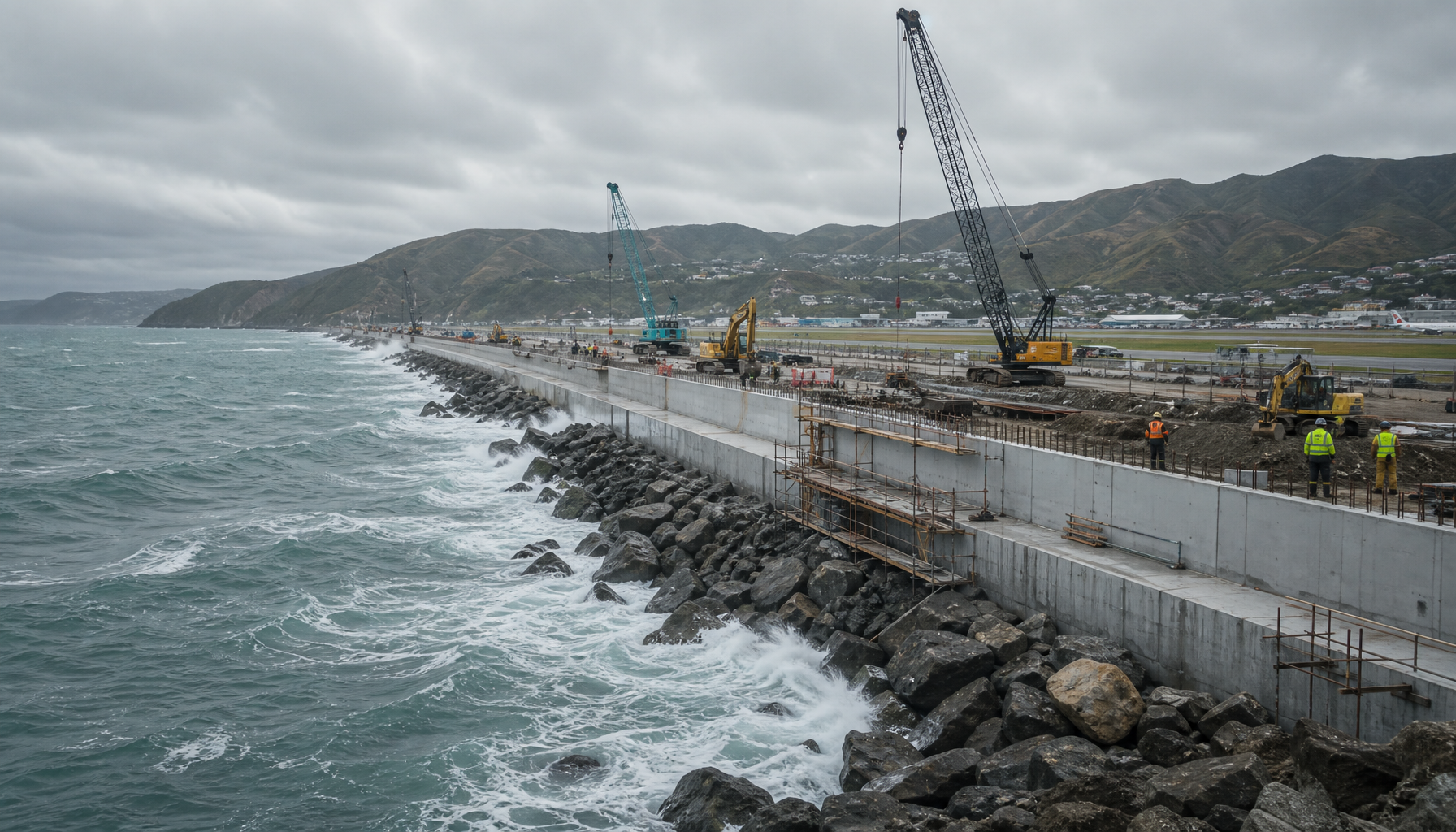
Illustration: The $100m+ Southern Seawall Renewal will upgrade 400 metres of coastal infrastructure protecting Wellington Airport's runway from storm and erosion risk. Generated illustration · EconomicNews.nz
Airport's Regional Economic Footprint
Wellington International Airport supports more than 14,500 full-time equivalent jobs. It contributes around $2 billion to regional GDP each year. Annual regional expenditure linked to the airport totals $3.9 billion.
Wellington Airport regional economic indicators
Figures based on year ending March 2024.
Source: BERL Economic Contribution Report, October 2024
No Direct Crown Outlay
No direct Crown spending occurs. The project instead avoids future repair and disruption costs. These risks could otherwise impose large regional losses during coastal storms.
The benefit-cost ratio exceeds standard infrastructure benchmarks. It supports long-term fiscal sustainability by protecting a key transport asset.
The Broader Fast-Track Pipeline
The Fast-track Approvals Act 2024 replaced earlier temporary rules. It lists 149 projects in Schedule 2. Another 47 projects remain in progress as of mid-May 2026. Average decision time stands at 118 working days from completeness.
The broader pipeline shows faster delivery of resilience works. Similar approvals could follow for other coastal and airport projects.
Airport Performance and Tourism Context
Tourism arrivals reached 3.52 million in the year to January 2026. Reliable airport operations underpin visitor spending and business connectivity.
Wellington Airport invested $111.3 million in infrastructure during FY2025/26. It handled 5.1 million passengers and reported EBITDAF of $133.4 million.