Willis Urges Voters to Back Budget 2026 as Surplus Returns One Year Early
Finance Minister Nicola Willis closed Budget 2026 by telling Kiwis they 'just need to choose it, they just need to vote for it' as Treasury forecasts an earlier return to OBEGALx surplus.
The New Zealand Treasury published the Investment Decision Assurance Policy on 13 October 2026. The framework consolidates the Gateway reviews and Te Waihanga's Infrastructure Priorities Programme into one investor-focused process effective 1 November 2026.
The Green Party announced a $5.9 billion economic development plan on 13 October 2026 that it claims will create 284,000 jobs over four years, 64,000 more than Treasury forecasts.
National Finance spokesperson Nicola Willis stated that income tax cuts are off the table until after a return to surplus, projected for 2028/29 under Treasury forecasts.
Finance Minister Nicola Willis closed Budget 2026 by telling Kiwis they 'just need to choose it, they just need to vote for it' — a direct appeal to supporters as Treasury forecasts an earlier return to OBEGALx surplus, one year ahead of the December 2025 Half Year Economic and Fiscal Update.
"Kiwis can look forward with confidence, they just need to choose it, they just need to vote for it." — Nicola Willis, Finance Minister (RNZ, 28 May 2026)
Finance Minister Nicola Willis delivered Budget 2026 on 28 May 2026. She described the package as a responsible plan to secure New Zealand's future amid global uncertainty.
Treasury's Budget Economic and Fiscal Update 2026 projects an OBEGALx surplus of $2.6 billion, or 0.5 percent of GDP, in 2028/29. This date is one year earlier than the December 2025 Half Year Economic and Fiscal Update forecast.
Net core Crown debt will peak at 46.1 percent of GDP in 2027/28 before falling to 44.4 percent by the end of the forecast period. The government will issue $6 billion less in bonds over four years than previously planned.
A Restrained Operating Package
The net operating package totals $2.1 billion per year on average. This figure sits under the $2.4 billion allowance. New spending of $3.8 billion is offset by $1.7 billion in savings and revenue measures.
Core Crown expenses are forecast to fall to 30.3 percent of GDP by 2029/30. This level approaches the long-term fiscal objective of 30 percent.
Real GDP growth is projected at 1.2 percent for the year to June 2026. Growth then rises to 2.3 percent by June 2027 and 3.2 percent by June 2028.
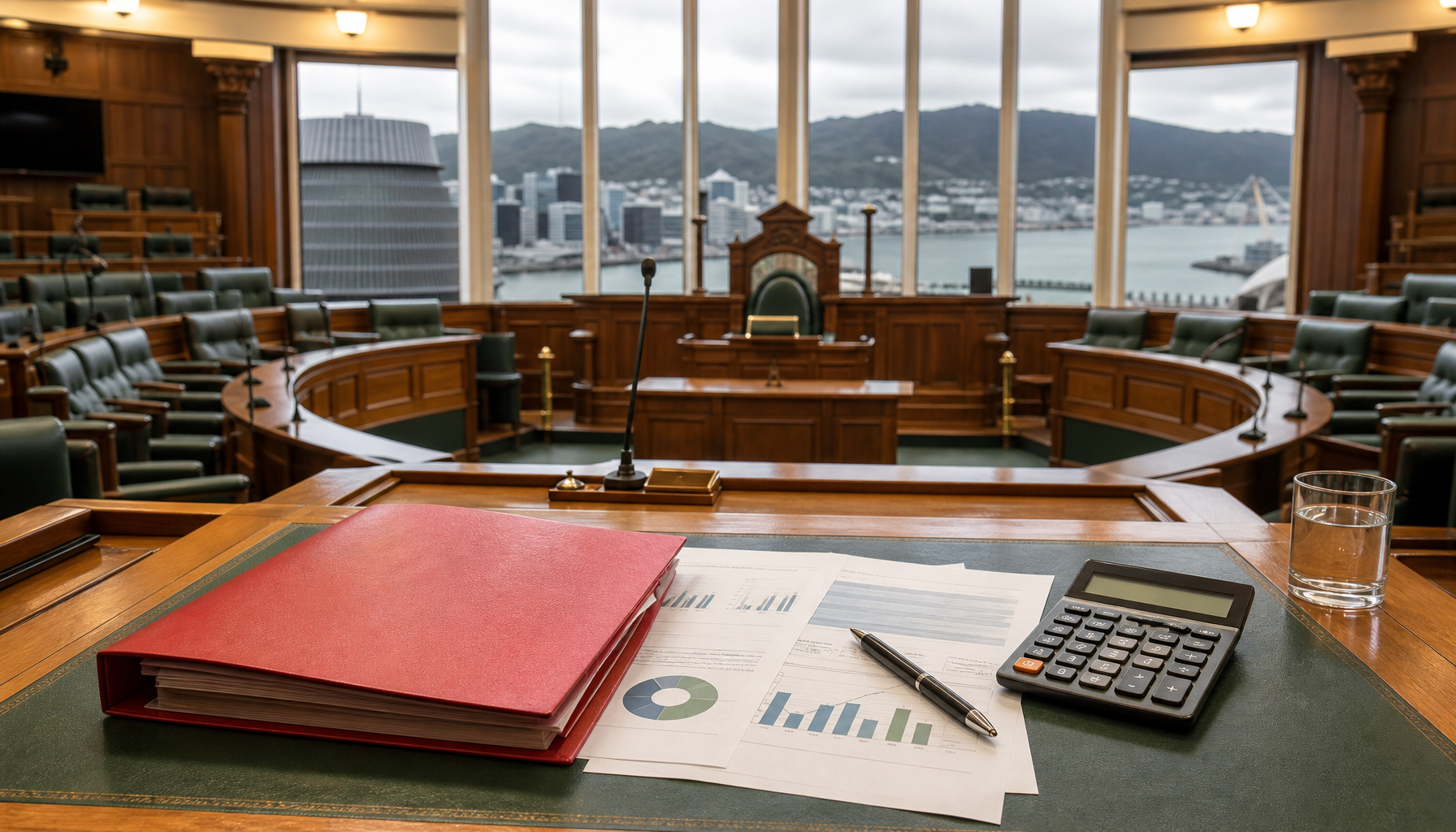
AI illustration of a New Zealand parliamentary chamber setting, used here to illustrate the delivery of Budget 2026 and the fiscal choices at the centre of the coalition government's pre-election pitch.
Real GDP Growth Forecasts
Accelerating growth underpins job creation and wage gains.
Source: Budget Economic and Fiscal Update 2026
Employment is expected to expand by 220,000 over four years. Average wages are forecast to grow 3.1 percent annually.
Core Crown tax revenue is projected more than $9 billion higher over the forecast period than in the prior update. Over 90 percent of the revision stems from factors unrelated to the Middle East fuel situation.
New capital investment totals $7 billion. The funds target health, education, transport and justice infrastructure.
Bank Levy and Super Fund
A new prudential levy on banks and other financial institutions is expected to raise around $209 million over four years.
Government contributions to the New Zealand Superannuation Fund will total $3.1 billion over the next four years. This amount is $2.2 billion more than expected at the December update.
Coalition and Opposition Fault Lines
Opposition parties criticised the approach. Labour leader Chris Hipkins said the growth forecasts remain lower than pre-election levels.
"Those economic growth forecasts are still lower than they were before the election." — Chris Hipkins, Labour leader (RNZ, 28 May 2026)
Green Party co-leader Chlöe Swarbrick stated that kids in poverty cannot eat their surplus.
Te Pāti Māori co-leader Rawiri Waititi described the Budget as the least investment in Māori in the last 15 years.
"It's the least investment in Māori that we've seen in the last 15 years, when this government was the last in charge of the purse strings of our democracy." — Rawiri Waititi, Te Pāti Māori co-leader (RNZ, 28 May 2026)
ACT leader David Seymour warned that repeated tax measures risk building a larger government.
"If your answer to everything is to go out and find someone to tax, eventually you end up with a really big government and no money left for anybody else." — David Seymour, ACT leader (RNZ, 28 May 2026)
NZ First leader Winston Peters called Willis's comments on superannuation sustainability an unfortunate mistake.
Willis acknowledged coalition differences on the bank levy. She said she had not yet convinced partners but retained hope for a larger levy.
"I haven't been able to convince my coalition partners yet, but I retain hope." — Nicola Willis, Finance Minister (RNZ, 28 May 2026)
Fuel Support and Savings Measures
The package includes temporary support during the fuel price spike. This covers a $50 per week increase to the in-work tax credit for up to 157,000 families and $150 million for strategic fuel reserves.
Savings measures include ending the final year of the Fees Free scheme and $368 million in lower operating expenses from Kāinga Ora efficiencies.
The earlier surplus and restrained spending reduce pressure on taxpayers over the medium term. Debt servicing costs stay contained while revenue rises support future fiscal space.