AIP Growth visa to allow Build to Rent funds from Dec 2026 — Economic News
AIP VISA · BUILD TO RENT FUNDING
AIP Growth visa opens Build to Rent funds from December 2026
From December 2026, Active Investor Plus Growth applicants can count approved managed funds that support Build to Rent toward their NZD $5 million New Zealand investment, Immigration Minister Erica Stanford announced.
The Treasury published the Digital, Equipment and Change Assurance Framework on 23 October 2026. The guide operationalises Cabinet's April 2026 decision to improve assurance over high-risk data, digital, equipment and organisational change investments.
The New Zealand Treasury published the Investment Decision Assurance Policy on 13 October 2026. The framework consolidates the Gateway reviews and Te Waihanga's Infrastructure Priorities Programme into one investor-focused process effective 1 November 2026.
New Zealand's repeated swings between banning and reviving offshore oil and gas exploration have left Taranaki with falling gas reserves, an industrial exit, and new taxpayer commitments through the Gas Security Fund.
From December 2026, investor migrants in the Active Investor Plus (AIP) Growth category will be able to invest in approved managed funds that support Build to Rent developments.
Immigration Minister Erica Stanford said the change keeps the Growth category focused on business growth while giving investors another option. The minimum investment remains NZD $5 million. Applicants must still meet all AIP requirements.
Build to Rent exposure will be available only through approved managed funds. Direct investment in Build to Rent developments will not qualify. Applicants and their family members cannot live in a Build to Rent project funded by their own investment.
Housing Minister Chris Bishop linked the move to rental supply. Building and Construction Minister Simon Watts said investment and building settings should pull in the same direction.
The April 2025 reset
The announcement sits on top of the April 2025 AIP reset. That reform cut the old roughly NZD $15 million threshold, created Growth and Balanced tracks, and removed the English-language test.
Immigration New Zealand data updated through mid-2026 show the reset's scale. Since 1 April 2025, INZ has received 904 AIP applications and approved 467. Growth accounts for 772 of those applications.
Around NZD $4.935 billion has been added to the pipeline or committed, excluding withdrawn and declined cases. Capital committed stands at NZD $2.72 billion. The investment pipeline is NZD $2.215 billion.
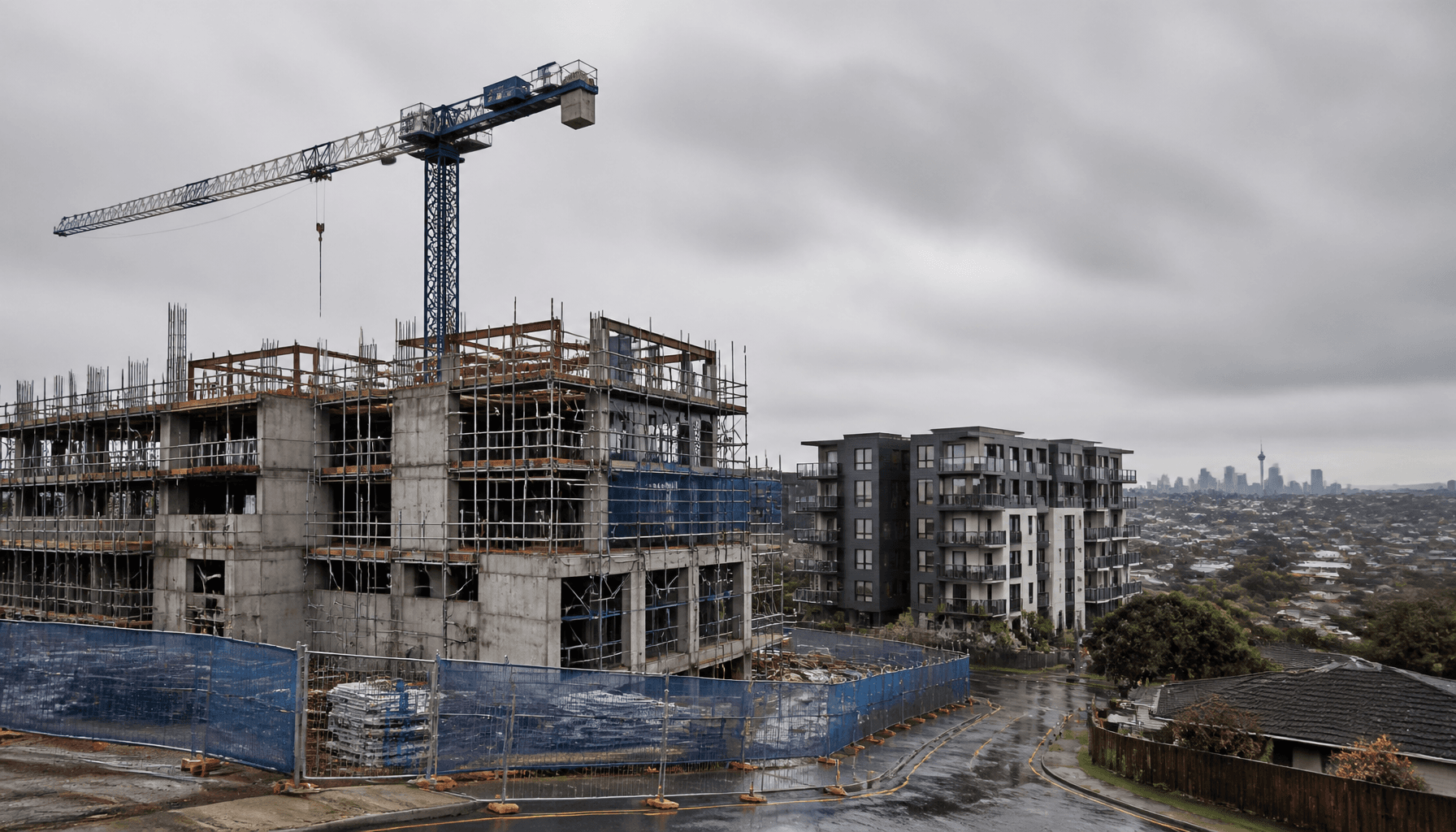
Multi-unit apartment construction in Auckland, where the bulk of New Zealand's Build to Rent stock under construction and in the pipeline is concentrated.
Where the money has gone
Growth capital has concentrated in managed funds. Of committed Growth capital broken down by type in INZ's July 2026 cut, managed funds totalled about NZD $1.2 billion, or 80 percent of that slice. Private credit alone was NZD $842.1 million.
Direct business investment remained thin at about NZD $27 million in the same breakdown. Industry commentary has asked whether Growth functions partly as a capital-parking channel. The managed-fund-only BTR rule keeps the same governance wrapper.
Industry commentary has asked whether Growth functions partly as a capital-parking channel.
Invest New Zealand maintains the acceptable managed funds list against Appendix 15 criteria. Managers must be FMA-licensed New Zealand residents. Holdings sit in New Zealand dollars. Underlying assets need a substantial New Zealand connection.
The Financial Markets Authority supervises managed investment schemes. Immigration New Zealand polices visa conditions and retention checkpoints. Detailed operational rules are to appear on the Immigration New Zealand website before the December 2026 start.
A small but growing asset class
Build to Rent remains a small but growing institutional class. Property Council New Zealand's tracker, with Colliers, CBRE, JLL and Bayleys, counted 2,552 completed units, 1,443 under construction and 4,367 in the pipeline as at 30 June 2026.
Auckland dominates under-construction and pipeline activity. Otago, led by large Queenstown projects, is the other standout. Domestic platforms such as Simplicity Living have led early delivery.
Parliament earlier created a streamlined Overseas Investment pathway for overseas buyers of existing large rental developments of 20 or more dwellings that will stay leased. That 2025 amendment addressed developer exit-liquidity concerns.
Build to Rent supply, New Zealand
COMPLETED UNITS
2,552
UNDER CONSTRUCTION
1,443
PIPELINE
4,367
Property Council NZ tracker, as at 30 June 2026.
Source: Property Council New Zealand / Build To Rent NZ tracker
Consents rebound
Dwelling consents have rebounded. Stats NZ reported 40,581 new homes consented in the year ended June 2026, up 19 percent. Multi-unit homes made up just over half of that total.
HUD's mid-2026 housing update noted consenting recovery while actual residential building work still lagged intentions. New-tenancy rents rose 1.0 percent nationally in the year to June 2026 after earlier declines.
Open questions
Stanford framed the visa change as competitiveness policy. Bishop cast Build to Rent as purpose-built long-term rental stock. Watts tied capital attraction to construction delivery.
Open questions remain for regulators and markets. Additionality is not automatic. AIP money into BTR funds may refinance projects domestic capital would have funded, or it may expand equity for marginal schemes.
Fund-manager selection, fee structures and true development-risk exposure sit with NZTE list criteria and FMA licensing. INZ will still test investment retention at Growth checkpoints.
Implementation turns on list updates and Immigration New Zealand instructions before December 2026. Households and developers will watch whether new fund product deepens rental starts in Auckland and Queenstown, or mainly reshuffles existing Growth allocations.