Australia's Consumer Sentiment Plunge Signals Recession Risk With Trans-Tasman Spillovers
Australian consumer sentiment has collapsed to multi-decade lows, the clearest leading indicator that the economy heads toward its first recession since 1991.
ASB’s Q2 2026 Regional Economic Scoreboard left Wellington joint last with Gisborne while Canterbury led on dairy cash, jobs and retail. The capital’s multi-quarter underperformance is structural: public-service consolidation, a deep housing correction and stalled population growth colliding with a national OCR still set for nationwide inflation.
Economists expect New Zealand’s June quarter GDP to rise just 0.1–0.2 percent when Stats NZ reports on 17 September, a sharp slowdown from March’s 0.8 percent gain as elevated oil prices compress real incomes.
Finance Minister Nicola Willis has refused the Reserve Bank’s first bid to roll $10.1 million of 2025/26 underspend into 2026/27 and published three criteria that will govern every future variation under the 2025–30 Five-Year Funding Agreement.
Australian consumer sentiment has collapsed to multi-decade lows, the clearest leading indicator that the economy heads toward its first recession since 1991.
Australia's consumer confidence hits wall
The Westpac–Melbourne Institute Consumer Sentiment Index fell 12.5 per cent to 80.1 in April 2026. The ANZ-Roy Morgan Consumer Confidence index reached 64.1 by mid-May, the fourth-lowest reading since 1973.
These levels match COVID-era lows and sit more than 20 points below year-ago readings. Business confidence surveys have also cratered, with one hitting a record low of 76.5.
The drivers
Higher fuel prices from the Middle East conflict have lifted headline inflation to 4.1 per cent year-ended to March 2026. The Reserve Bank of Australia responded with an eighth rate hike, lifting the cash rate to 4.35 per cent in May.
Household disposable income rose 1.8 per cent in the December 2025 quarter, yet nominal spending grew only 1.1 per cent. The saving ratio climbed to 6.9 per cent, its highest since late 2022.
Strong population growth from migration has propped up aggregate GDP while per-capita measures already flirt with contraction. This pattern reveals how unchecked immigration can mask underlying weakness rather than build sustainable prosperity.
Australian Consumer Sentiment vs. Cash Rate, 2024–2026
Westpac–Melbourne Institute index and RBA cash rate target at each decision point.
Source: Westpac-Melbourne Institute; Reserve Bank of Australia
The trade-offs
RBA Governor Michele Bullock has warned that further hikes raise recession risk. She described the 1.3 per cent growth outlook as anaemic.
She described the 1.3 per cent growth outlook as anaemic. — Michele Bullock, RBA Governor
The board split 8-1 on the May hike. Hawks prioritised inflation control. Doves feared demand destruction from higher borrowing costs on already debt-heavy households.
Fiscal cash splashes risk fuelling further inflation, complicating the RBA's task. Government spending that shields households from market signals ultimately raises the cost of adjustment for everyone.
Second-order effects
New Zealand faces direct spillovers. Two-way goods trade exceeds $30 billion annually. NZ exports to Australia totalled US$5.92 billion in 2025, led by precious metals and dairy.
Major NZ banks owned by Australian parents will feel any rise in non-performing loans across the Tasman. Credit standards here could tighten even if local conditions remain firmer.
Higher fuel prices hit New Zealand harder as a small open economy. Finance Minister Nicola Willis has noted that such shocks knock small economies around more than larger peers.
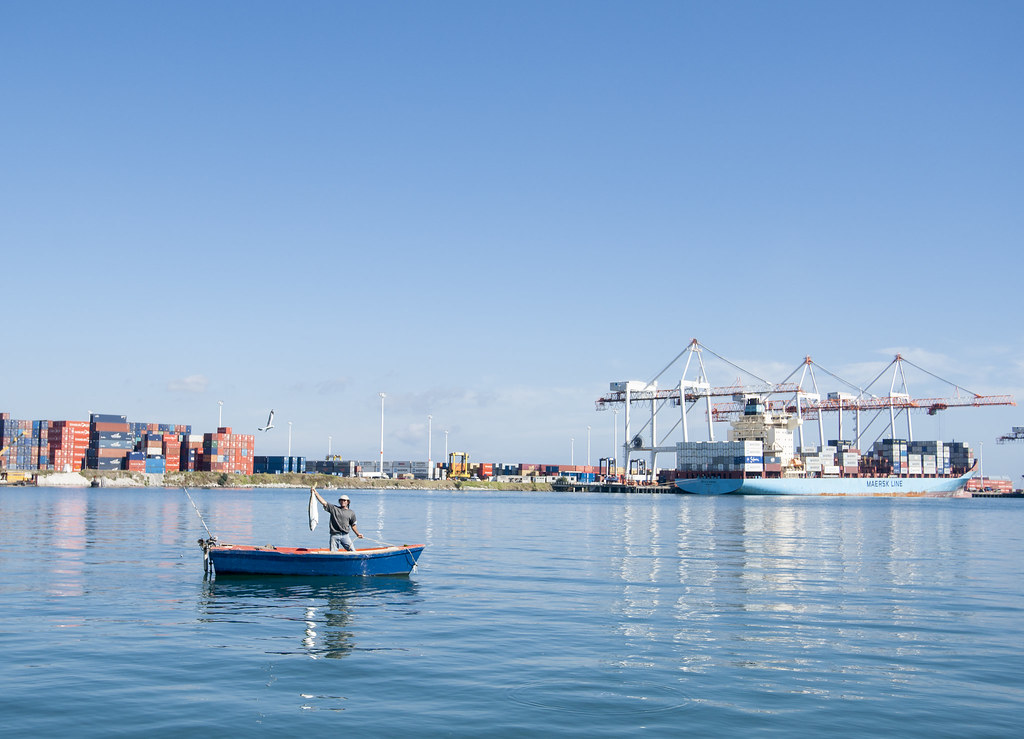
Port of Tauranga, through which a significant share of New Zealand's US$5.92 billion in annual exports to Australia flows — trade volumes now at risk if Australian household spending contracts. Photo: "Port of Tauranga" by brianscantlebury.com · CC BY-SA 2.0
Historical context
Australia's last recession ran from September 1990 to September 1991. GDP fell 1.7 per cent, employment dropped 3.4 per cent and unemployment peaked at 10.8 per cent.
That episode stemmed from high real interest rates near 17.5 per cent and commercial property collapse after deregulation. Today's risks combine geopolitical energy shocks with restrictive monetary policy and elevated household debt.
The counter-argument
Baseline forecasts from the IMF, Deloitte and KPMG project 1.9 to 2.0 per cent growth for 2026. They assume quick resolution of supply disruptions and only a mild slowdown.
Resilient labour markets with unemployment near 4.1 to 4.3 per cent and household wealth up 2.5 per cent to $18.8 trillion provide buffers. No technical recession has occurred yet.
Yet sentiment data and repeated forecaster downgrades suggest downside risks dominate if tensions linger. Per-capita GDP weakness already shows the limits of relying on migration-driven population growth.
Open questions
How long will Strait of Hormuz disruptions persist?
Will the sentiment collapse appear in June quarter spending data?
What impact will the 8-1 RBA board split have on the future rate path?
NZ resilience opportunity
Westpac forecasts New Zealand GDP growth of 3.3 per cent in 2026, outpacing Australia's downgraded outlook. This divergence could support the NZD-AUD cross rate while pressuring export competitiveness if Australian demand weakens.
NZ policymakers should watch Australian data closely for spillovers into the exchange rate and commodity prices. At the same time, the episode underscores the value of avoiding Australia's mix of high debt, energy dependence and migration-driven population surges that mask per-capita stagnation.