Gentrack Group Limited reported recurring revenue of $85.3 million for the six months ended 31 March 2026, up 12 percent, even as statutory net profit fell 29 percent to $5.1 million due to two delayed utilities deals.
"The long sales cycles, and two unexpected new client delays, have had an impact on our results this first half, but does not change our confidence in our medium-term growth targets of more than 15 percent compound annual growth."Gary Miles, Gentrack Chief Executive
New Zealand rural confidence stayed positive for a ninth straight quarter in August 2026, with horticulturalists overtaking sheep and beef as the most optimistic sector while investment plans stayed soft.
Cabinet’s Economic Policy Committee has formally authorised public consultation on a prudential levy to shift Reserve Bank supervision costs onto banks, insurers and market infrastructure operators from 2027/28.
Parliament passed the India Free Trade Agreement legislation 93–29 on 16 September 2026. Preferential tariffs await mutual ratification, with Indian officials pointing to mid-to-late October entry into force.
Gentrack Group Limited posted recurring revenue of $85.3 million for the six months ended 31 March 2026, up 12 percent from the prior period. Statutory net profit after tax dropped 29 percent to $5.1 million while total revenue eased 1.7 percent to $110.1 million. The result stems from two delayed non-recurring utilities client deals in characteristically long sales cycles of six to 18 months.
The drivers behind the result
Recurring revenue from subscriptions, support and managed services continued its steady climb. This segment reached $85.3 million, up from $76.4 million a year earlier, according to the company's half-year market announcement. Non-recurring licence and implementation fees bore the brunt of the timing delays.
The company completed two strategic acquisitions that embed advanced capabilities. The Factor deal adds AI-powered pricing intelligence for energy retailers. The Veovo division agreed to acquire Dubai Technology Partners, expanding airport operations into the Middle East.
CEO Gary Miles emphasised the transition. "The long sales cycles, and two unexpected new client delays, have had an impact on our results this first half, but does not change our confidence in our medium-term growth targets of more than 15 percent compound annual growth."
"The long sales cycles, and two unexpected new client delays, have had an impact on our results this first half, but does not change our confidence in our medium-term growth targets of more than 15 percent compound annual growth." — Gary Miles, Gentrack Chief Executive
Market demand in utilities arises from genuine commercial needs for dynamic pricing and decarbonisation responses.
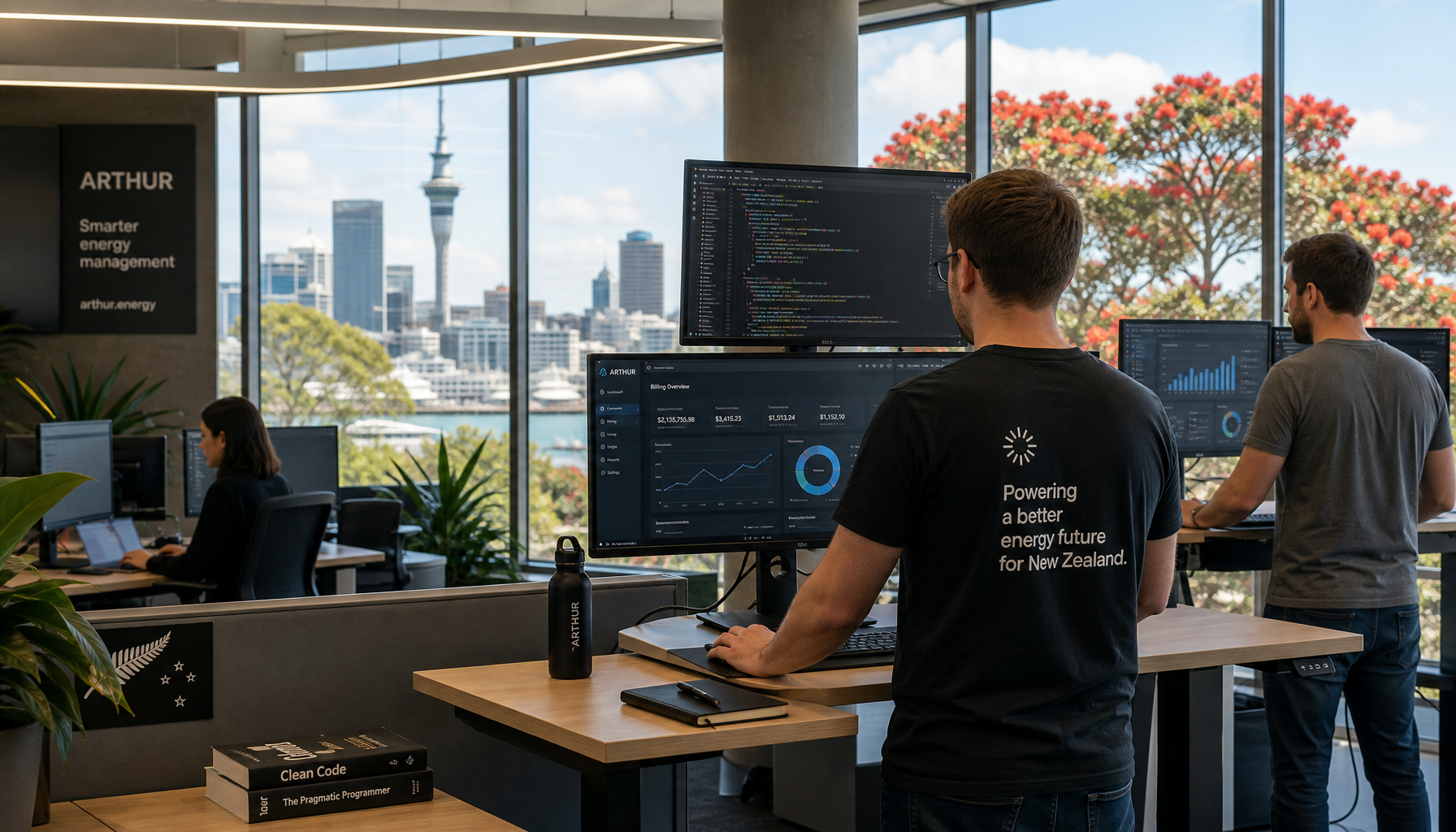
AI illustration of a New Zealand enterprise software workspace of the kind Gentrack operates from Auckland and Wellington, where the company maintains significant R&D and customer-success teams.
Trade-offs in the transition to higher recurring models
Management accepted near-term EBITDA compression to prioritise the g2.0 platform shift. H1 EBITDA excluding acquisition costs stood at $7.9 million. Full-year guidance now points to $13.5 million to $20 million.
Near-term compression reflects deliberate investment in the g2.0 platform transition.
Source: Gentrack Group Ltd Half Year Results 2026 Market Announcement
The board chose an on-market share buyback of up to $20 million rather than an interim dividend. Chairman Andy Green stated that the board's view is that a share buyback would be appropriate and accretive to shareholders, noting that the programme is supported by a strong balance sheet and would not undermine the company's ability to continue to fund organic and inorganic growth.
Second-order effects for New Zealand
Gentrack retains high-value R&D and customer success roles in Auckland and Wellington through these acquisitions. Successful integration supports digital export earnings and the tax base.
Over 12 to 24 months, execution on g2.0 and the new platforms could lift margins toward the 15 to 20 percent target once onboarding costs decline.
AI illustration of the two strategic capabilities Gentrack acquired in H1 FY26: AI-powered energy pricing intelligence via the Factor deal, and expanded airport operations technology through the Veovo division's acquisition of Dubai Technology Partners.
Historical context and peer comparison
Enterprise software in regulated sectors has always featured variable one-off revenues. Gentrack itself experienced distorted comparisons in FY23-24 from insolvent customer revenues.
Peer Hansen Technologies reported stronger 1H26 results with operating revenue up 7.3 percent and underlying EBITDA up 46.1 percent. Differing execution shows market selection at work.
Gentrack recurring revenue trend: H1 FY25 to FY26 guidance
Recurring revenue has grown consistently even as non-recurring project fees have fluctuated with deal timing.
Source: Gentrack Group Ltd Half Year Results 2026 Market Announcement; Gentrack FY25 Annual Report; Gentrack FY26 guidance update 5 May 2026
The counter-argument and resilience signals
Recurring revenue momentum, a $73.2 million cash balance, Factor's native integration into g2, and Dubai expansion provide clear visibility. Analyst consensus holds an Outperform rating with a $6.825 average target price.
These elements support the unchanged 15 percent-plus medium-term CAGR ambition despite the share price reaction to the guidance update.
Open questions for the coming periods
Pipeline conversion rates for the delayed deals remain to be seen. Exact margin trajectory after g2.0 costs fall will emerge in future results. NZ utilities adoption pace following Electricity Authority reforms offers another data point.
Forward outlook
Investors should watch the full-year results and buyback execution for confirmation of the recurring revenue trajectory and margin improvement path.