Hospitality Firms Told to Electrify as Government Policies Fuel Energy Volatility
New Zealand hospitality operators face mounting energy bills from a renewable-heavy grid undermined by policy choices that have left prices volatile and rising. Free advice from the Energy Efficiency and Conservation Authority offers one path forward, yet businesses would do better to act on market signals rather than rely on another taxpayer-funded program.
New Zealand rural confidence stayed positive for a ninth straight quarter in August 2026, with horticulturalists overtaking sheep and beef as the most optimistic sector while investment plans stayed soft.
ASB’s Q2 2026 Regional Economic Scoreboard left Wellington joint last with Gisborne while Canterbury led on dairy cash, jobs and retail. The capital’s multi-quarter underperformance is structural: public-service consolidation, a deep housing correction and stalled population growth colliding with a national OCR still set for nationwide inflation.
MBIE’s 6 September snapshot shows 51.7 days of petrol cover on paper. Only 34.5 of those days sit onshore. Eight of nine ships still float outside the EEZ, and sequential Hormuz then Red Sea stress is already priced into $3-plus petrol.
New Zealand hospitality operators face mounting energy bills from a renewable-heavy grid undermined by policy choices that have left prices volatile and rising. Free advice from the Energy Efficiency and Conservation Authority offers one path forward, yet businesses would do better to act on market signals rather than rely on another taxpayer-funded program.
Illustration: Induction cooking is central to EECA's electrification pathway for New Zealand's food and beverage sector, where energy costs can represent a large share of operating expenses.
The pressure builds on small operators
Hospitality businesses across New Zealand confront sustained rises in electricity costs that government renewable targets have helped create. Average prices reached 39.3 cents per kWh by November 2025, with a further 2.6 percent increase in the March 2026 quarter according to Stats NZ household living-costs data. Commercial users, including kitchens and hotels, feel the hit directly because energy forms a large share of operating expenses.
The call to electrify operations comes from industry groups partnering with EECA. This government agency provides free pathways for food and beverage operators and hotels. Yet these programs represent another layer of public spending at a time when fiscal discipline matters most. Small owner-operated cafes and restaurants already run on thin margins and do not need more bureaucracy to tell them what market prices already signal.
Policy decisions to accelerate renewables without adequate firming capacity have left the system exposed. The OECD Economic Survey of New Zealand 2026 highlights structurally high prices driven by dwindling gas reserves and insufficient backup. This is not an accident of nature but the predictable result of rushing targets while ignoring reliability.
Tourism recovery brings additional demand. Stats NZ recorded 358,900 international visitor arrivals in March 2026. While revenue helps, high visitor numbers strain infrastructure and energy use in a sector already squeezed. Rapid population and visitor growth from loose immigration settings has compounded the load without matching supply reforms.
NZ Electricity Price Rise: Quarterly Trend
Bars show the percentage change in household electricity costs per quarter. The March 2026 quarter recorded the steepest recent rise.
Switching from gas to electric systems cuts network charges and improves cooking performance, as shown in EECA case studies such as East restaurant in Auckland using induction woks. Payback can fall under six months with co-funding. However, upfront costs and disruption remain real for businesses that have already absorbed years of cost pressure.
The RBNZ Financial Stability Report May 2026 notes many hospitality SMEs have run down cash buffers since 2020 due to energy and other costs. Relying on government co-funding risks dependency rather than genuine efficiency. Market-driven upgrades, funded by operators themselves, align incentives better than subsidised checklists.
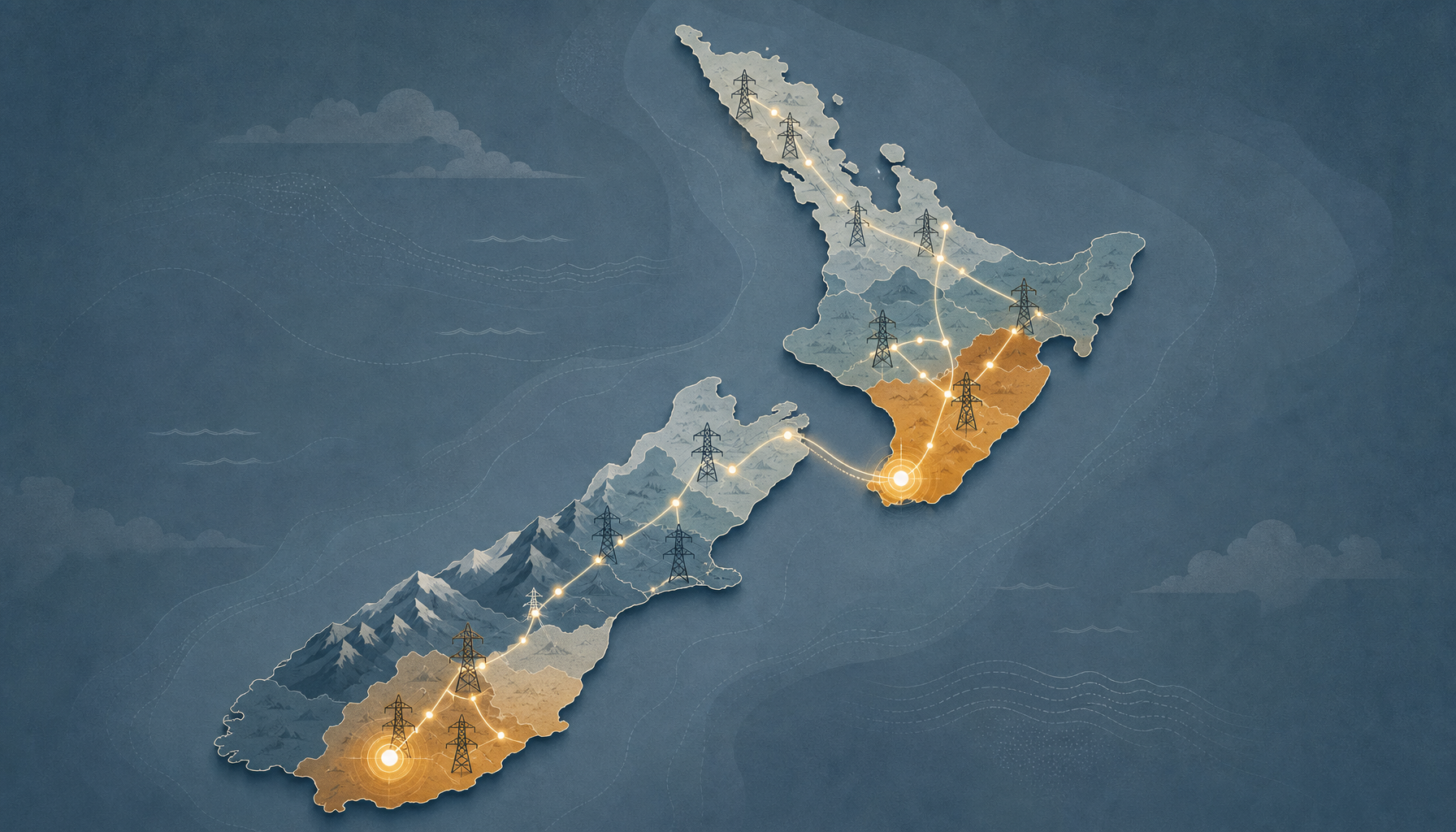
Regional price differences exceed 40 percent, from 34.61 cents per kWh in Wellington to 48.93 cents in Balclutha per MBIE data. Operators in high-cost areas face steeper challenges. Uniform national policies ignore these realities.
Illustration: Regional electricity prices vary by more than 40% across New Zealand — from Wellington in the south of the North Island to Balclutha in Otago — creating uneven cost pressures for hospitality operators.
Regional Electricity Prices: Selected NZ Regions
Balclutha faces the highest retail electricity costs among monitored regions — nearly 41% above Wellington rates.
Source: Ministry of Business, Innovation and Employment (MBIE) electricity cost and price monitoring
Second-order effects on jobs and costs
Preserving margins in a sector employing 193,000 people directly, according to Hospitality New Zealand, supports wage growth and avoids staff cuts. Yet passing costs to diners risks higher restaurant prices, already up 2.8 percent year-on-year to March 2026 per Stats NZ.
Broader spillovers include construction for fit-outs and supply chains. Without faster firming, the OECD warns of dampened investment in energy-intensive activities. Persistent volatility threatens the $21.4 billion revenue base rather than delivering stable growth.
Historical parallels
The 2022 global energy shock showed early adopters of efficiency measures maintained margins while gas-dependent peers struggled. New Zealand has pursued efficiency strategies for decades through EECA, yet uptake among small firms remains slow due to awareness gaps and thin margins.
Today's situation differs because renewable penetration is higher, yet price stability has not followed. Policy emphasis on targets over reliability repeats past errors.
The counter view on futures
Some analysts point to long-dated wholesale contracts moderating as new solar, wind and battery projects come online. This suggests hedged operators may see relief by 2028 without immediate full electrification. Short-term volatility remains elevated, however, and retail prices still face 5 to 9 percent rises in 2026 per Consumer NZ and Electricity Authority forecasts.
Evidence from MBIE and the Electricity Authority shows lines charges driving much of the increase, a direct outcome of regulatory settings. Waiting for distant futures ignores immediate margin pressure on thousands of small businesses.
Open questions ahead
Actual uptake of EECA tools among owner-operators remains unclear. Net costs of co-funding versus emissions gains need scrutiny. Regional price gaps and their impact on tourist locations warrant monitoring.
Firming capacity additions will determine whether volatility eases or persists. Next data from Stats NZ on visitor arrivals and MBIE energy quarterly reports will reveal whether demand pressures outpace supply reforms.
What businesses should watch
Operators should prioritise electrification where payback stands clear on current prices, funded internally rather than through additional government programs. Watch for lines charge adjustments from April 2026 and any moves to import LNG that could stabilise supply. Fiscal restraint on energy agencies would free resources for genuine market solutions instead of more advice services. Tourism growth must be matched by infrastructure that does not rely on endless subsidies.