Meat Industry Association names Nick Beeby chief executive amid record exports
The Meat Industry Association has appointed Nick Beeby as chief executive effective 1 July 2026. Beeby succeeds Sirma Karapeeva and takes the role at a time when New Zealand red meat and fifth-quarter exports reached a record $11.7 billion in calendar 2025.
New Zealand rural confidence stayed positive for a ninth straight quarter in August 2026, with horticulturalists overtaking sheep and beef as the most optimistic sector while investment plans stayed soft.
ASB’s Q2 2026 Regional Economic Scoreboard left Wellington joint last with Gisborne while Canterbury led on dairy cash, jobs and retail. The capital’s multi-quarter underperformance is structural: public-service consolidation, a deep housing correction and stalled population growth colliding with a national OCR still set for nationwide inflation.
MBIE’s 6 September snapshot shows 51.7 days of petrol cover on paper. Only 34.5 of those days sit onshore. Eight of nine ships still float outside the EEZ, and sequential Hormuz then Red Sea stress is already priced into $3-plus petrol.
The Meat Industry Association has appointed Nick Beeby as chief executive effective 1 July 2026. Beeby succeeds Sirma Karapeeva and takes the role at a time when New Zealand red meat and fifth-quarter exports reached a record $11.7 billion in calendar 2025.
Appointment at record export levels
The Meat Industry Association announced on 26 May 2026 that Nick Beeby will become chief executive from 1 July. He replaces Sirma Karapeeva, who resigned in February after six years. Beeby has served as chief executive of the New Zealand Meat Board since January 2025.
MIA independent chairman Nathan Guy said the appointment strengthens the organisation, noting that Beeby's existing chief executive experience in the red meat sector made the appointment a positive step forward. Guy added that Beeby stood out for experience in strategy, market development, quota administration and industry assurance.
Export performance in 2025
MIA data show red meat and fifth-quarter exports totalled $11.7 billion in 2025, up 19 percent from 2024. Beef exports fell 7 percent in volume to 447,610 tonnes but rose 15 percent in value to a record $5 billion. Sheepmeat exports held steady at 371,222 tonnes yet surged 31 percent in value to $4.7 billion, with average prices reaching $12.62 per kilogram.
The United States took the largest share at $3.2 billion, up 17 percent. China followed at $2.5 billion, up 2 percent. The European Union rose 42 percent to $1.8 billion. The United Kingdom increased 64 percent to $858 million. Canada grew 52 percent to $644 million.
Stats NZ reported total meat exports hit $10 billion in the year ended October 2025, the first time the annual figure reached that level and an increase of $1.6 billion.
NZ Red Meat Export Value by Market, 2025
Value growth was broad-based across all major markets.
Source: Meat Industry Association export release 2025
The New Zealand Meat Board role
Beeby has led the New Zealand Meat Board since January 2025 after joining in 2021 as general manager of quota and information. The board administers tariff-rate quotas that delivered nearly $1.4 billion in tariff savings for the year ended September 2025 on exports to restricted markets including the United States, European Union and United Kingdom.
The US beef and veal quota stands at 213,402 tonnes with an in-quota tariff of approximately 4.4 US cents per kilogram versus 26.4 percent out of quota. These savings reduce exporter costs and support farmgate returns through processor schedules.
Broader economic contribution
MIA members operate more than 60 plants employing over 25,000 people directly. Plants process around 22.9 million sheep and 4.6 million cattle annually, with 90 percent value-added and 86 percent exported to more than 110 destinations. Beef + Lamb New Zealand analysis attributes nearly 92,000 full-time equivalent jobs to the red meat sector, or 4.7 percent of national employment.
The food and fibre sector accounted for 15.3 percent of GDP in the year to March 2024 according to the Ministry for Primary Industries Situation and Outlook for Primary Industries December 2025. Export earnings support the current account and regional economies in Hawke's Bay, Canterbury, Southland and Waikato.
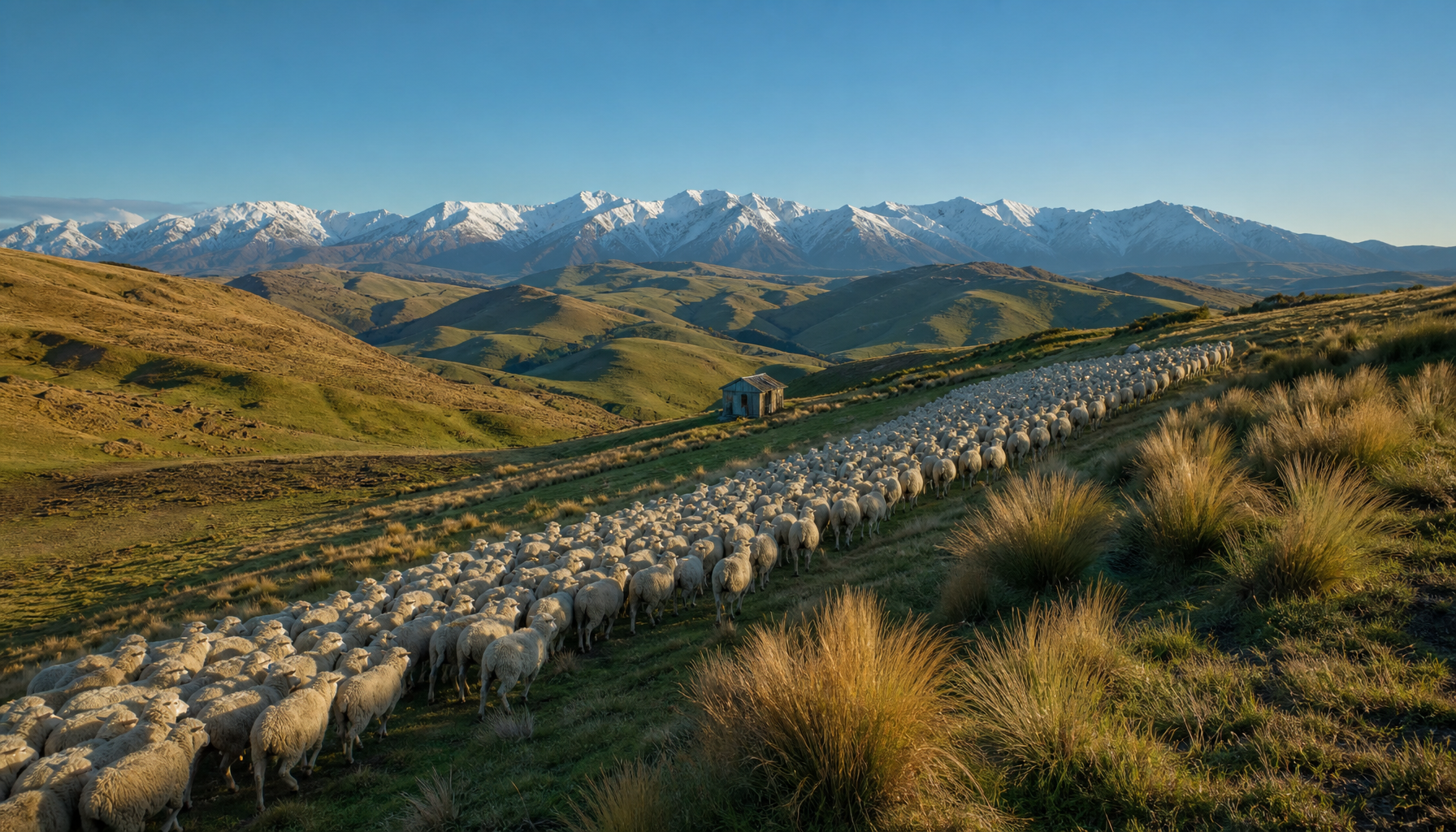
AI illustration of New Zealand high-country sheep farming — the pastoral base of the $11.7 billion red meat export sector that Beeby will lead as MIA chief executive from July 2026.
Drivers behind the 2025 results
Global supply constraints supported prices. According to USDA data, the US cattle herd reached a 73-year low as of January 2024 and continued contracting into 2025. European sheep flocks declined to their lowest recorded headage, according to the Agriculture and Horticulture Development Board, while Australian sheepmeat exports fell. New Zealand's free-trade agreements with the European Union, United Kingdom, CPTPP partners and recent deals with India and the UAE-GCC lowered barriers.
The Ministry for Primary Industries Situation and Outlook for Primary Industries December 2025 forecast meat and wool export revenue rising 7 percent to $13.2 billion in the year to June 2026, driven by prices. Beef and veal prices were expected up 9 percent to $11.20 per kilogram. Sheepmeat prices rose 10–12 percent.
Trade-offs and regulatory pressures
Value growth occurred alongside volume pressures. According to Stats NZ, sheep numbers fell 21 percent between 2014 and 2024. Grassland area declined 10 percent or 809,000 hectares over the same period, also per Stats NZ. The New Zealand Emissions Trading Scheme incentivises conversion of productive farmland to forestry, reducing land available for livestock — a policy tension that industry voices have flagged as raising compliance costs for farmers and processors.
Quota savings of $1.4 billion lower costs for exporters. Yet rising protectionism, potential US tariffs and China safeguard enquiries create downside risks flagged by Treasury and industry voices. Regulatory requirements around sustainability and assurance add costs that must be weighed against premium market access gains.
Historical shift in the sector
New Zealand red meat moved from a volume-driven commodity exporter in the 1990s, when meat comprised about 20 percent of goods exports, to a value-focused industry. Productivity gains reached 42 percent between 2000 and 2024 through genetics and heavier carcass weights. These improvements supported volumes despite falling livestock numbers.
Prior leadership transitions occurred during export booms and downturns driven by drought, disease and shifting trade conditions. The current dual structure of MIA advocacy and NZMB quota management has built resilience across cycles.
Second-order effects for households and regions
Strong export earnings bolster the current account and support the New Zealand dollar. Direct employment of over 25,000 in processing plants transmits income to households in plant towns. Broader multipliers reach 92,000 jobs including transport, logistics, farm inputs and value-adding.
Over the next 12 months Beeby's combined MIA and NZMB experience may accelerate quota optimisation and market diversification into India and the Gulf. Over two to three years influence on sustainability regulations, climate adaptation and workforce policy could shape processor investment and farmgate prices. Reserve Bank of New Zealand monitoring of export-led growth will watch for any inflation spillovers.
Counter-argument on volume fragility
Some analysts emphasise volume fragility and over-reliance on the United States market amid potential tariff resurgence. They note China beef imports from South America contrast with softer New Zealand performance there. According to Meat & Livestock Australia, Australia recorded red meat and livestock turnover of $77.1 billion in 2023–24 with exports of $19.5 billion, highlighting scale advantages in processing efficiency.
Evidence from 2025 shows price-driven value growth outweighed volume declines. Multiple free-trade agreements and tight global supply delivered record revenues. Beeby's operational experience in quota administration and market development positions the industry to address both diversification and regulatory navigation.
Open questions ahead
How Beeby's dual role interacts with the Ministry for Primary Industries and Ministry of Foreign Affairs and Trade on biosecurity and FTA utilisation remains to be seen. Treasury and Reserve Bank fiscal feedback from sector taxes and GST will emerge in upcoming forecasts. Workforce and R&D investment effects on the 25,000 direct plant jobs under ongoing climate policy will require monitoring.
The next Ministry for Primary Industries Situation and Outlook report and any developments in US trade policy will provide clearer signals on 2026 outcomes.