New Zealand Firms Hoard Cash Despite Solid Profits as Policy Uncertainty Bites
New Zealand businesses are prioritising cash reserves and balance-sheet strength over capital spending, even as operating profits hit $31 billion in the December 2025 quarter. This caution, triggered by geopolitical shocks and prolonged policy uncertainty, risks locking in weak productivity growth and lower living standards for years.
"These impacts on households and businesses, along with reduced confidence, could cause businesses to hold back on investing and households to save more as a precaution."Reserve Bank of New Zealand, Financial Stability Report May 2026
New Zealand rural confidence stayed positive for a ninth straight quarter in August 2026, with horticulturalists overtaking sheep and beef as the most optimistic sector while investment plans stayed soft.
ASB’s Q2 2026 Regional Economic Scoreboard left Wellington joint last with Gisborne while Canterbury led on dairy cash, jobs and retail. The capital’s multi-quarter underperformance is structural: public-service consolidation, a deep housing correction and stalled population growth colliding with a national OCR still set for nationwide inflation.
MBIE’s 6 September snapshot shows 51.7 days of petrol cover on paper. Only 34.5 of those days sit onshore. Eight of nine ships still float outside the EEZ, and sequential Hormuz then Red Sea stress is already priced into $3-plus petrol.
New Zealand businesses are prioritising cash reserves and balance-sheet strength over capital spending, even as operating profits hit $31 billion in the December 2025 quarter. This caution, triggered by geopolitical shocks and prolonged policy uncertainty, risks locking in weak productivity growth and lower living standards for years.
Profits Mask Deeper Caution
New Zealand firms recorded operating profits of $31 billion in the December 2025 quarter, up 13 percent from a year earlier. Sales rose 5.9 percent to $212 billion. Yet gross fixed capital formation contracted 2.2 percent in the same quarter, with the weakness concentrated in plant, machinery and transport equipment.
The divergence is not random. The ANZ Business Outlook survey showed business confidence crashing 43 points to -10.6 in April 2026 after the Middle East conflict escalated. Investment intentions fell to a net +3.3 from +14.5 the previous month. Employment intentions turned negative for the first time since mid-2024.
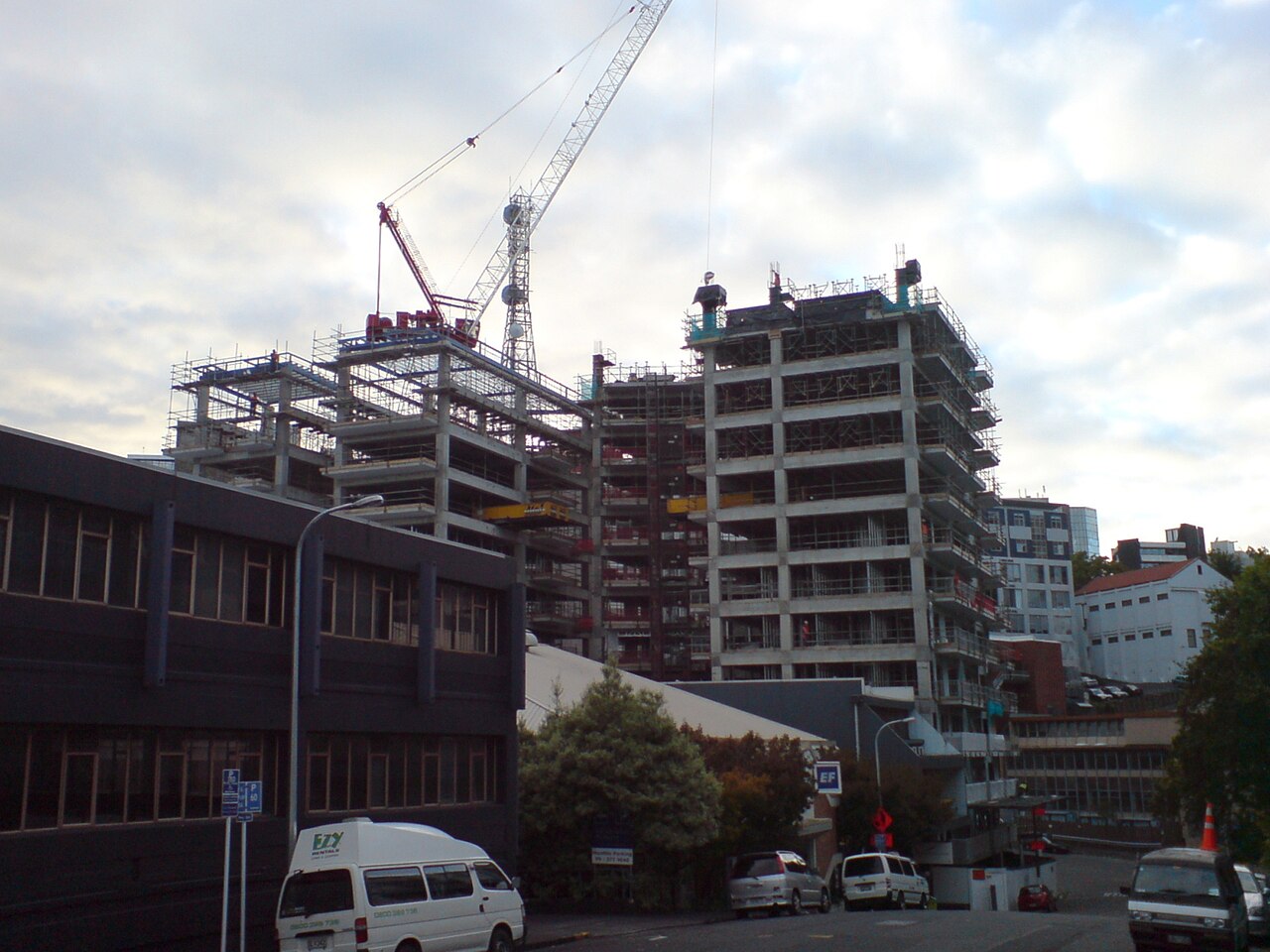
New Zealand's construction sector — one of the hardest-hit by the investment pullback — where many SMEs have already depleted cash buffers built up during the pandemic.
ANZ Business Confidence Index, March–April 2026
Confidence collapsed 43 points in a single month following the escalation of the Middle East conflict.
Source: ANZ Business Outlook April 2026
Drivers of Cash Hoarding
Geopolitical fuel and freight cost spikes lifted cost expectations to 90.4 percent of firms in the ANZ survey. Profit expectations swung negative. Treasury data show intangible assets now make up 27 percent of new business investment, reflecting efficiency plays rather than expansion.
Smaller firms in hospitality and construction have run down cash buffers since 2020 amid margin pressure. The Reserve Bank of New Zealand May 2026 Financial Stability Report notes business deposits have fallen as a share of GDP over the past three years, particularly among SMEs.
Lending spreads remain wide: 390 basis points above the 90-day bank bill rate for small firms, compared with 294 basis points in Australia. SMEs account for 64 percent of salaries and wages and 68 percent of operating profits yet hold only 23 percent of the banking sector loan book at $138 billion.
Illustration: A New Zealand commercial construction site operating below capacity — the building sector recorded some of the weakest investment intentions in the April 2026 ANZ Business Outlook survey.
SME Lending Spreads: New Zealand vs Australia
NZ small-firm spreads are nearly 100 basis points wider than Australian equivalents, raising the cost of external capital.
Source: RBNZ Financial Stability Report May 2026
Trade-Offs for Firms and the Economy
Firms face a rational choice between preserving internal funds and paying wider spreads for external credit. The Reserve Bank stress test showed the four largest banks' aggregate CET1 ratio troughing at 8.7 percent under severe geopolitical scenarios, well above the 6 percent minimum. This resilience comes at the cost of slower credit growth and delayed transmission of the 325 basis point OCR cuts delivered since August 2024.
“These impacts on households and businesses, along with reduced confidence, could cause businesses to hold back on investing and households to save more as a precaution.” — Reserve Bank of New Zealand, Financial Stability Report May 2026
Treasury forecasts net core Crown debt rising to 46.9 percent of GDP by 2027/28. Higher debt service costs and operating deficits limit fiscal room to support investment. Businesses respond by deferring capex, which in turn weakens tax receipts and compounds the debt trajectory.
Productivity Channel and Long-Term Costs
Weak capital deepening directly constrains output per worker. New Zealand already lags OECD peers in business investment per person in the labour force. The OECD 2026 Economic Survey points to shallow capital markets and low private pension savings as structural constraints on risk-taking by innovative firms.
Liquidations reached 2,867 in 2025, the highest since 2010. Sustained low investment intentions will widen the productivity gap versus Australia over the next two to five years. GDP growth forecasts sit near 2.5 percent for 2026 only if geopolitical risks ease; otherwise the lower end of 2 percent becomes the ceiling.
Historical Parallels
The pattern echoes the post-GFC period when New Zealand recorded the largest fall in business investment among developed countries. Private non-residential gross fixed capital formation contracted sharply before partial recovery by 2014. Finance company assets peaked at $25 billion before widespread failures. Liquidations peaked in 2010–12. Similar cash hoarding followed the 2020–22 pandemic and 2022–24 inflation shock.
Illustration: Idle capacity at a New Zealand light-industrial precinct — the kind of plant and machinery investment that firms are deferring as geopolitical uncertainty and wide SME lending spreads bite.
Counter-Argument: Resilience or Complacency?
Profits remain solid. Larger export-oriented firms continue selective investment in intangibles. Banks hold strong liquidity and capital buffers. The NAB Australian Business Survey also shows softening capex intentions, suggesting the shock is regional rather than unique to New Zealand. Some analysts describe the wait-and-see stance as prudent risk management.
Yet the data show investment intentions in buildings and plant turning negative again after a brief recovery in late 2025. Employment intentions have already flipped negative. The balance of evidence points to genuine capacity constraints rather than mere caution.
Second-Order Effects
Over the next 12 months, soft gross fixed capital formation will cap credit demand and slow the pass-through of lower interest rates. March 2026 business financial data, due 9 June, will reveal whether profit momentum persists amid cost pressures.
In two to three years, cumulative under-investment risks entrenching lower potential output. Treasury faces weaker corporate tax receipts while net core Crown debt climbs. The new Invest New Zealand agency, funded in Budget 2025, aims to lift foreign direct investment, but domestic SME caution may blunt complementary private-sector response.
Open Questions
Will the Middle East ceasefire stabilise fuel costs enough to revive investment intentions? Can the Depositor Compensation Scheme and dairy sector balance-sheet repair from the $3.2 billion Fonterra sale provide broader offsets? Will RBNZ Governor Anna Breman require clearer growth signals before further OCR moves?
Policy Implications
Restoring business confidence requires credible reduction in policy uncertainty and fiscal discipline. Government must cut wasteful spending that drives core Crown debt higher and creates the very uncertainty firms cite when hoarding cash. Regulatory burdens that widen lending spreads for SMEs must be eased. Immigration settings that add pressure to infrastructure without boosting productivity should be reviewed. Only then will the 325 basis point of rate relief translate into renewed capital formation rather than larger cash piles.