Stride cuts gearing to 34% as rate relief reaches property sector
Stride Property Group lowered its bank loan-to-value ratio to 34 percent in the year to 31 March 2026 while holding its dividend at 8.0 cents per share. The moves illustrate how Reserve Bank of New Zealand interest rate cuts have improved cash flow for commercial property borrowers.
"FY26 marked a year of meaningful strategic progress for Stride, enhancing resilience, operating strength and future growth optionality."Tim Storey, Chair — Stride Property Group FY26 Results
Cabinet’s Economic Policy Committee has formally authorised public consultation on a prudential levy to shift Reserve Bank supervision costs onto banks, insurers and market infrastructure operators from 2027/28.
Australian-based users viewing New Zealand property listings jumped 190% year-on-year in August, realestate.co.nz said, after Canberra tightened capital gains and negative gearing rules on new residential investments.
Finance Minister Nicola Willis has refused the Reserve Bank’s first bid to roll $10.1 million of 2025/26 underspend into 2026/27 and published three criteria that will govern every future variation under the 2025–30 Five-Year Funding Agreement.
Stride Property Group reduced its bank loan-to-value ratio to 34 percent for the year ended 31 March 2026. The listed investor also maintained its full-year dividend at 8.0 cents per share. These outcomes show the direct effect of lower official cash rates on commercial property balance sheets.
Net profit after tax rose to $31.3 million from $21.7 million in the prior year. Distributable profit increased 2 percent to $49.1 million. Net rental income fell $10.2 million to $58.9 million after asset sales and a portfolio restructure.
The company sold the Silverdale Centre and completed the Industre restructure. These moves removed $6.6 million from recurring rental income. Management fee income from the funds arm rose 12 percent to $22.9 million as assets under management reached $3.3 billion.
Gearing reduction signals healthier borrower position
Bank LVR stood at 34 percent at balance date, down from 39 percent a year earlier. Look-through gearing reached 35.1 percent with $166 million of headroom. The Reserve Bank of New Zealand noted in its May 2026 Financial Stability Report that banks' assessment of commercial property loans has particularly improved with lower interest rates.
Commercial property accounts for roughly 29 percent of banks' $138 billion SME lending book. Improved loan assessments reduce the share of stressed loans. Stride's conservative position places it ahead of many sector peers.
Dividend payout reached 91.1 percent of distributable profit. The board guided the same 8.0 cents per share for FY27. This stability supports income for KiwiSaver funds and other retail investors holding New Zealand property exposure.
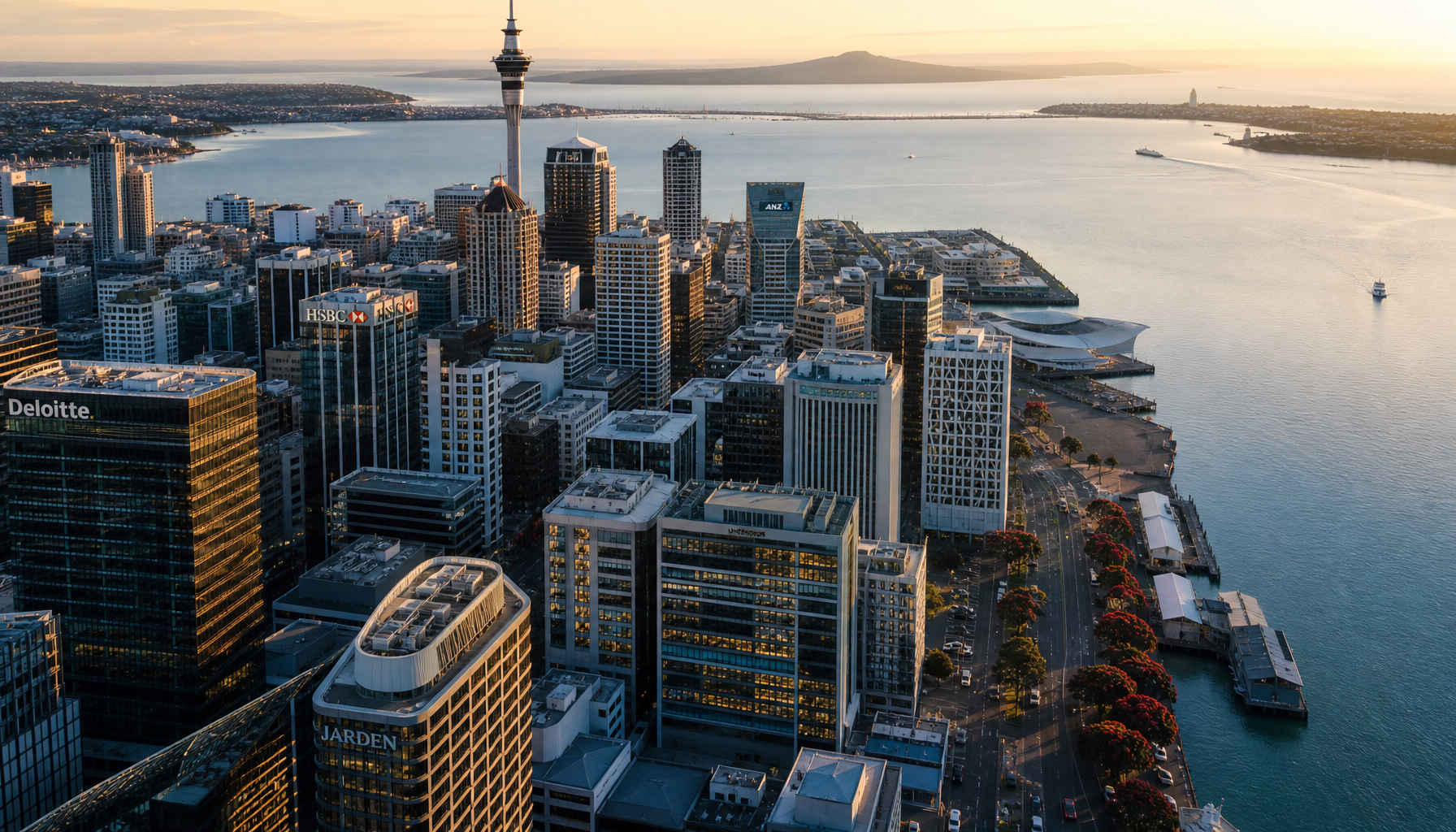
AI illustration of Auckland's CBD commercial office precinct, where Stride Property holds repositioned assets at 34 Shortland Street amid a bifurcated market showing 16% overall vacancy.
Net rental income dropped after the Silverdale sale and Industre changes. Like-for-like rental growth across the look-through portfolio still reached 2.3 percent. Occupancy held at 94 percent with a 6.6-year weighted average lease term.
Office assets proved weaker. The $670 million office portfolio recorded 86 percent occupancy. Repositioned buildings at 34 Shortland Street and 215 Lambton Quay delivered 6.2 percent like-for-like growth on 57,000 square metres. Town centre assets showed 0.9 percent growth at 92 percent occupancy.
Auckland CBD office vacancy sat at 16.0 percent in the second half of 2025 according to JLL data. Prime vacancy was 10.8 percent while secondary reached 22.1 percent.
Portfolio recycling funds industrial growth
Stride completed two Industre developments valued at $93.7 million. These assets delivered a 6 percent yield on cost and a 15-year weighted average lease term. A further $70 million Patiki Road project remains committed.
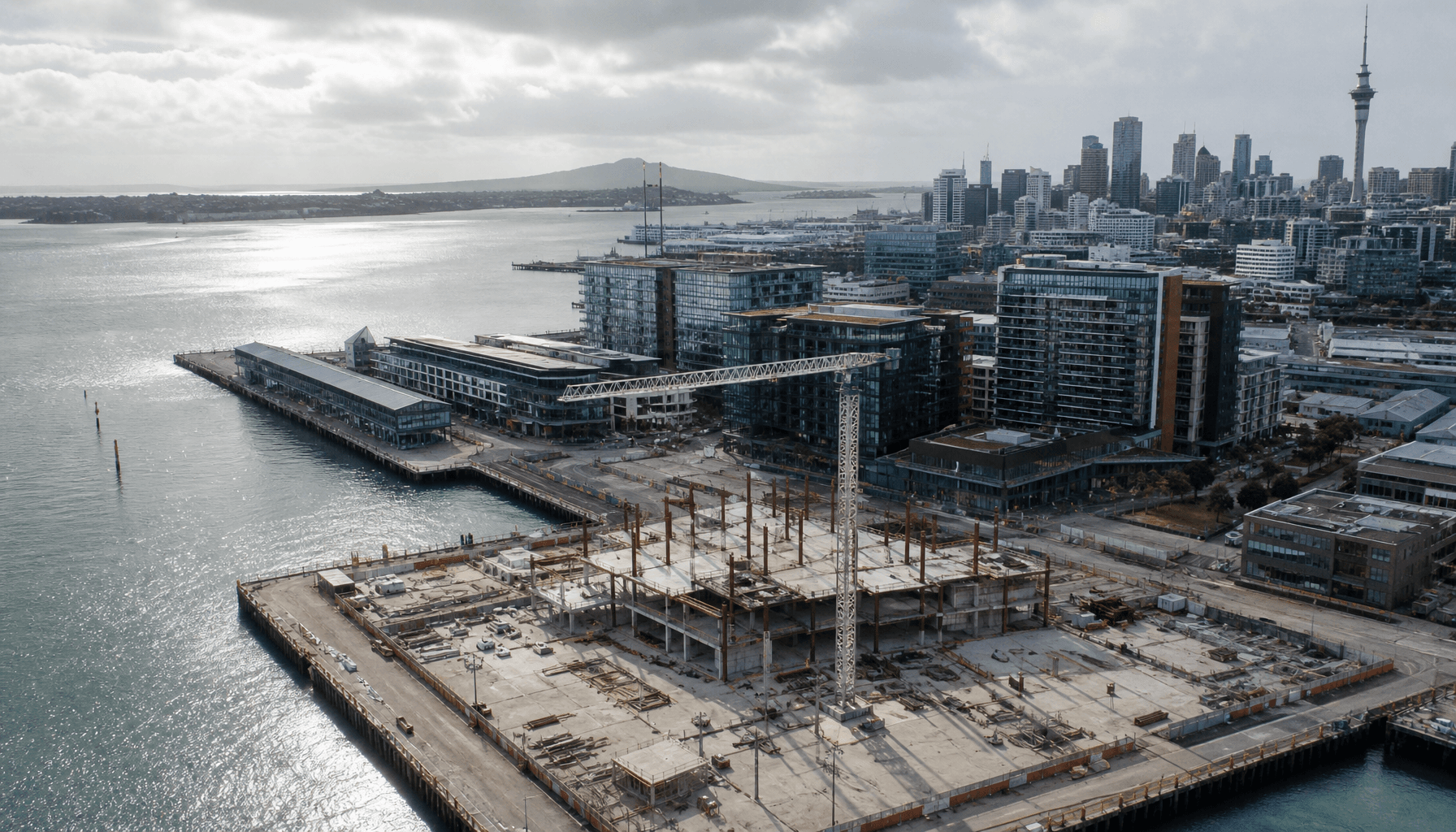
The group entered a conditional 125-year pre-paid ground lease at North Wharf in Wynyard Quarter. Resource consent was submitted after balance date. These moves shift the portfolio toward higher-yielding industrial and mixed-use opportunities.
Investore, a Stride product, acquired Bunnings New Lynn and Silverdale Centre while divesting two supermarkets at premiums to book value. The strategy trades short-term rental income for longer-term development upside.
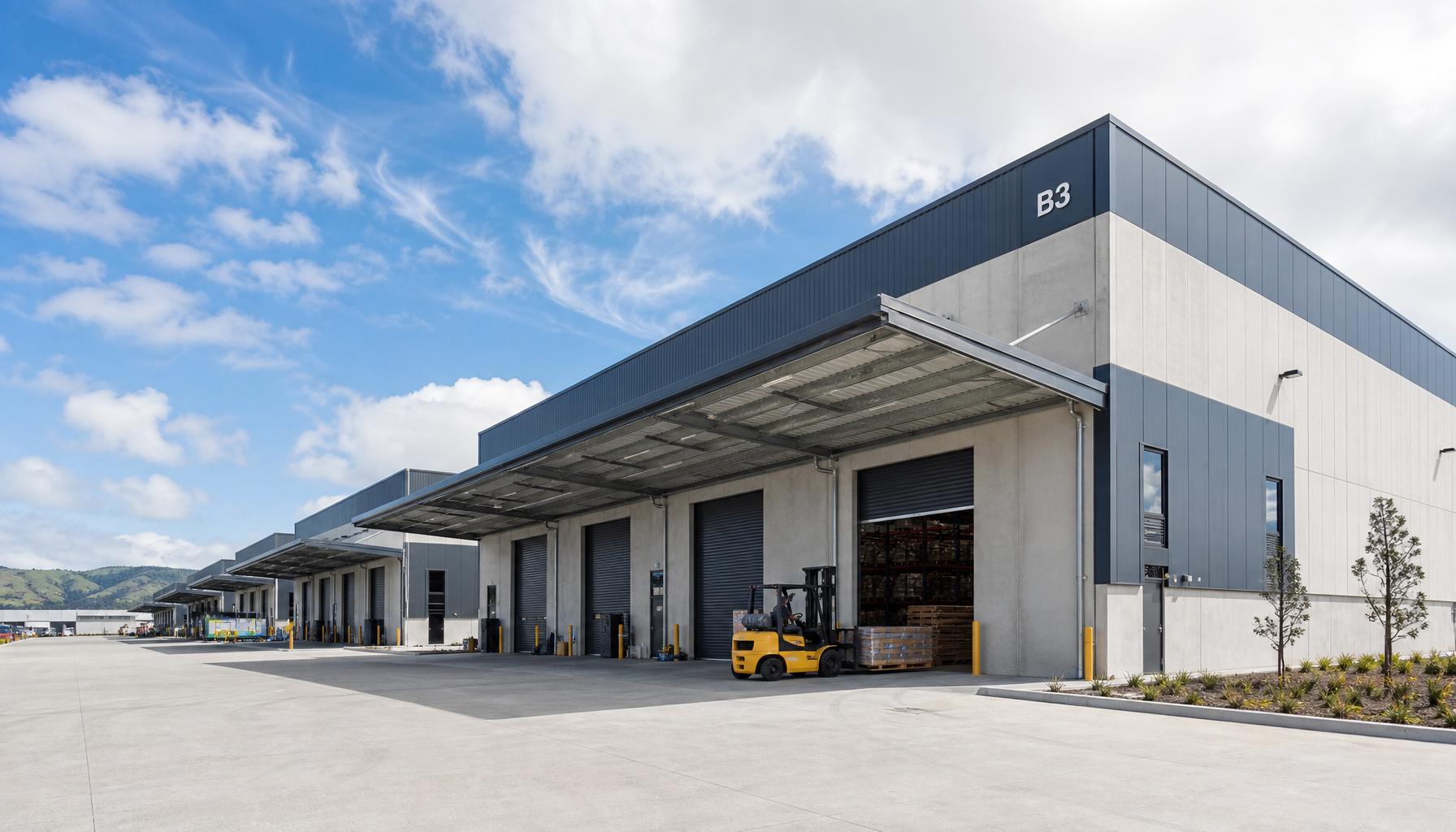
AI illustration of an Auckland industrial logistics complex, representative of Stride's Industre developments — including the completed Wickham Street and Favona Road assets valued at $93.7 million — which are driving portfolio recycling toward higher-yielding industrial opportunities.
RBNZ flags geopolitical risks to recovery
The Reserve Bank May 2026 Financial Stability Report highlighted risks from the Middle East conflict that began after February 2026. Higher oil prices raise costs for transport, chemicals and primary sectors. Inflation pressures could slow economic recovery and leasing momentum.
Banks remain well capitalised and deposit funded. Commercial property borrower health improved before the conflict through lower rates. Non-performing loans still lag. Stride's reduced gearing limits its exposure to any renewed stress.
“FY26 marked a year of meaningful strategic progress for Stride, enhancing resilience, operating strength and future growth optionality.” — Tim Storey, Chair, Stride Property Group
CBRE forecasts total returns for New Zealand commercial property to reach around 12 percent in 2026. Rental growth and modest yield compression are expected to drive the rebound. Stride's 6.2 percent portfolio cap rate and 94 percent occupancy align with this outlook.
Peer results show mixed industrial and office performance
Precinct Properties reported investment property funds from operations of $69.2 million for the half-year to December 2025. Funds from operations per security fell to 3.18 cents. Net tangible assets per security declined to $1.18.
Property for Industry posted profit after tax of $46.9 million, up $18.2 million. Funds from operations rose 32.2 percent to 6.40 cents per share. Goodman Property Trust NZ noted stable Auckland industrial rents after a prior 6 percent compound annual growth rate.
Australian comparisons from CBRE show national office effective rents forecast to rise 3.3 percent in 2026. Brisbane and Sydney are expected to lead with gains above 6 percent. Industrial assets continue to benefit from constrained supply.
Historical pattern repeats post-rate cycle
Stride's FY23 and FY24 results carried large valuation losses as rates rose and cap rates expanded. FY25 and FY26 show partial reversal plus active recycling. Net rental income was $72.3 million in FY24 before the recent decline.
The shift toward funds management and development mirrors earlier recoveries. Fee income now provides a buffer against rental volatility. Net tangible assets per share edged down to $1.69 from $1.72.
Stride Net Rental Income, FY24–FY26
The decline reflects deliberate portfolio recycling — Silverdale sale and Industre restructure — rather than like-for-like deterioration.
Source: NZX FY26 Annual Results Announcement — Stride Property Group
Trade-offs between payout and retained earnings
The 91.1 percent payout ratio supports investor income but leaves less retained capital for development. Office repositioning carries capex risk. The company flagged a potential 5 to 6 percent longer-term impact to distributable profit per share if external investors in Diversified seek liquidity.
Near-term project fees from the North Wharf lease and Industre pipeline offer an offset. Lower leverage gives capacity for further investment without increasing debt ratios.
Second-order effects on households and construction
Stable dividends support retirement savings in KiwiSaver schemes with property allocations. Industrial developments add Auckland logistics capacity and sustain construction employment. Reduced gearing lowers the sector's contribution to bank stress metrics monitored by the Reserve Bank.
Any sustained softening in leasing would pressure future distributable profit. Further asset sales could affect transaction volumes across listed and unlisted markets.
Some observers point to the 86 percent office occupancy and rental income decline as evidence of ongoing secondary asset weakness rather than a successful pivot. The Reserve Bank continues to flag vacancy risks in non-prime stock despite rate relief.
Geopolitical oil price shocks could reverse leasing momentum faster than the CBRE 12 percent return forecast assumes. Secondary office supply in Auckland remains elevated.
Stride's data shows 2.3 percent look-through rental growth and strong performance on repositioned assets. The 34 percent LVR and $166 million headroom provide a buffer against slower recovery.
Open questions on sustainability and disclosure costs
It remains unclear whether 2.3 percent like-for-like growth will hold if Middle East oil prices persist. The exact FY27 impact of any Diversified liquidity event is unknown. The 6.2 percent cap rate and 94 percent occupancy could face pressure if secondary office supply stays high.
Upcoming sustainability disclosure rules may add compliance costs for smaller managers. Stride improved its GRESB score to 79 out of 100 and advanced its carbon reduction plan.
Outlook hinges on recovery pace and oil prices
Stride's execution of the North Wharf opportunity and Industre pipeline will influence Auckland waterfront and industrial values over the next 12 to 24 months. Occupancy and rental outcomes will serve as a bellwether for secondary office and town centre assets.
The Reserve Bank will release its next Financial Stability Report in November 2026. That update will show whether rate relief continues to offset geopolitical headwinds for commercial property borrowers.